Ripple has launched Ripple USD (RLUSD), a stablecoin tied to the U.S. dollar. You can think of it as digital dollars moving across Ripple’s blockchain, designed for simple, everyday use.
Stablecoins like RLUSD are built to cut down on price swings. If you’ve seen how Bitcoin can shoot up or crash in a single day, you’ll understand why. RLUSD avoids that by holding steady at around one U.S. dollar. This makes it easier to send, save, or spend without worrying about sudden losses.
Ripple created RLUSD to make cross-border payments and on-chain finance smoother. It combines the stable value of a dollar with Ripple’s fast payment system, giving users a reliable digital option. RLUSD runs on both the XRP Ledger and Ethereum, so it can be used across different blockchain networks.
For beginners, stablecoins feel less intimidating than most cryptocurrencies. RLUSD is a good entry point because you don’t face big price risks. Imagine a business paying overseas suppliers in RLUSD; both sides know the value will stay the same the next day.
As crypto adoption continues to rise, stablecoins are becoming more important. RLUSD joins a crowded field but stands out thanks to Ripple’s network and reputation. It offers transparency, speed, and security, making it useful for both people and companies.
In this guide, we’ll break down how RLUSD works, its main uses, and how it compares with other stablecoins. We’ll also look at its pros and cons, plus how it’s different from XRP. By the end, you should feel clear and confident about what RLUSD brings to the table.
How Does RLUSD Stablecoin Work?
Ripple USD works like a digital version of the U.S. dollar. For every RLUSD created, Ripple keeps one real dollar in reserve. This setup makes sure the token always stays equal in value to one dollar.
As of August 2025, there are about 666.7 million RLUSD in circulation. This gives it a market cap of roughly $666 million, according to CoinMarketCap data. You can get RLUSD through exchanges or platforms that support it, such as Bitget, Kraken, and Bitstamp.

RLUSD works in pretty much the same way as other stablecoins. When you buy the token, an equal amount of dollars is stored safely in Ripple’s reserves. If you decide to cash out, your RLUSD is destroyed, or “burned,” and you receive dollars back. This simple system is called minting and burning.
A big advantage of RLUSD is that it works on multiple blockchains. Ripple launched it on the XRP Ledger and Ethereum. On the XRP Ledger, transactions are fast and cheap. On Ethereum, RLUSD can connect with many decentralized apps. This gives users the best of both worlds.
Ripple also makes sure the token follows strict rules. The reserves are held in regulated U.S. banks, and independent audits check that every RLUSD matches a dollar in reserve. This adds trust and transparency for anyone using it.
Sending RLUSD is just like sending any other crypto token. The coins move from one wallet to another within seconds. No banks, no middlemen, and no waiting days for a transfer to clear. The value stays the same at one dollar the whole time.
On Ethereum, RLUSD can also be used with smart contracts. That means developers can plug it into apps for lending, borrowing, or payments. On the XRP Ledger it supports instant cross-border payments. So, whether you’re a developer or a business, RLUSD has different ways to fit your needs.
Now, you might wonder: who’s actually in charge of all this? Ripple itself issues RLUSD and manages the reserves. This makes it different from decentralized stablecoins like DAI. The upside is that Ripple can act quickly if problems arise. The trade-off is that users need to trust Ripple to handle everything responsibly.
In short, RLUSD is simple to understand. It keeps its value with real dollar reserves, works on both XRPL and Ethereum, and supports fast, low-cost transactions. With Ripple overseeing compliance and transparency, RLUSD acts as a reliable digital dollar for everyday use.
RLUSD Use Cases
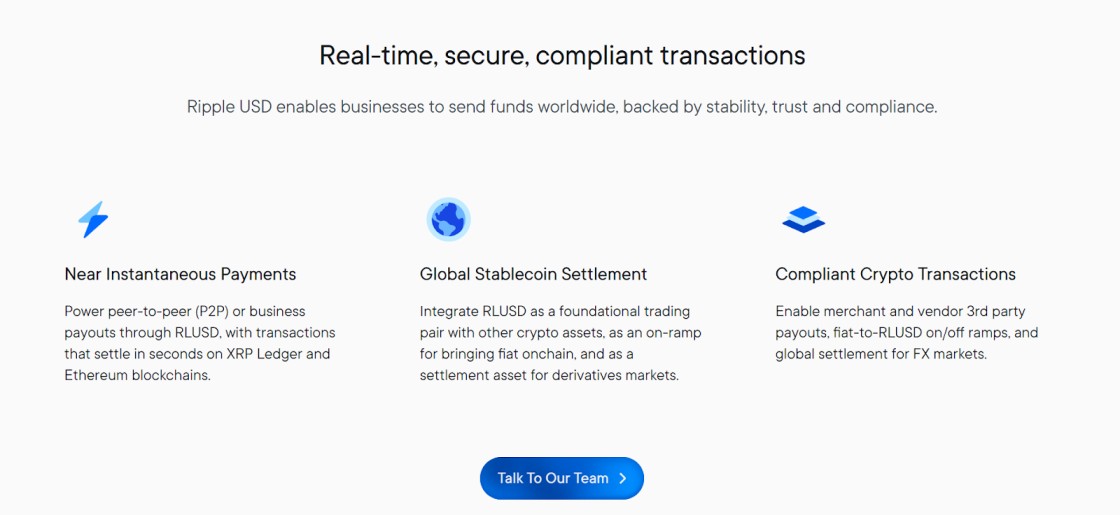
RLUSD has many practical uses for both people and businesses. Because it is tied to the U.S. dollar, you can count on it for everyday transactions without worrying about price swings. Here are some use cases:
Payments
One of the simplest uses is payments. Imagine sending RLUSD to a friend on the other side of the world. The transfer takes just seconds, and your friend receives the exact amount you sent. No long waits, and no expensive banking fees.
Cross-Border Trade
Businesses can also take advantage of RLUSD for international trade. Normally, paying suppliers in another country can take days. With RLUSD, the payment arrives almost instantly, and the value stays the same until it’s received. That means no surprises from price changes during the process.
Decentralized Finance (DeFi)
In the world of decentralized finance, RLUSD is also very useful. On Ethereum, it can be used in lending and borrowing apps. For example, you can lock up RLUSD to access extra funds, or borrow it as a steady, dollar-based collateral.
Remittances
Remittances are another important case. Millions of people send money home from abroad every year. But traditional transfers often eat into those amounts with high fees. With RLUSD, the money arrives faster, costs less to send, and families receive the full value as digital dollars.
E-Commerce
E-commerce is also growing as a space for stablecoins. Online shops can accept RLUSD for payments, knowing its value won’t suddenly drop like Bitcoin or other volatile coins. Merchants can choose to hold RLUSD or easily convert it back into cash.
Safe Haven in Crypto
And here’s a common question: what if you just want a safe spot in crypto without leaving the market? Stablecoins like RLUSD can serve as that “parking place.” Instead of cashing out to your bank, you can hold RLUSD on the blockchain until you’re ready to use it again.
To sum up, RLUSD can be used for payments, trade, remittances, e-commerce, and decentralized finance. Each example shows its main strengths — stability, speed, and low cost. That’s what makes it a useful digital dollar for both personal and business needs. RLUSD can also act as a safe haven in crypto, giving people a steady place to hold value when markets become unpredictable.
How Does RLUSD Compare to Other Stablecoins?
Stablecoins are among the most popular crypto assets today. They act as a bridge between regular money and blockchain, keeping value steady while making digital transfers easy. RLUSD joins this group alongside well-known names like USDT, USDC, and DAI. So how does it compare with them?
USDT (Tether) is the biggest stablecoin by market share. It has been around since 2014 and is used heavily for trading across exchanges. Like RLUSD, it is backed by reserves that match the number of tokens in circulation.
But here’s the issue: USDT has often faced doubts about transparency. Its audits and reports have been criticized as unclear. RLUSD, on the other hand, is entering the market with a stronger focus on clear audits and compliance. Ripple hopes this openness will give it an edge over Tether.
USDC (USD Coin) is another leading stablecoin, issued by Circle. It is backed by cash and U.S. treasuries, with detailed monthly audits to prove it. This has built a strong reputation for trust. RLUSD takes a similar approach, holding reserves in regulated U.S. banks to show users that their tokens are properly backed.
Both USDC and RLUSD aim to provide stable value for payments, finance, and digital transfers. The difference is in the networks they run on. USDC works on Ethereum, Solana, and more. RLUSD launched on the XRP Ledger and Ethereum, giving it a unique link to Ripple’s payment system.
DAI is a little different. It is a decentralized stablecoin created by MakerDAO. Instead of being backed by cash, it is supported by crypto assets like ETH locked into smart contracts. The supply of DAI adjusts automatically using rules and over-collateralization. RLUSD doesn’t work this way. It is centralized and fiat-backed, which makes it easier for beginners to understand, though less decentralized than DAI.
When it comes to use cases, each coin has its own space. USDT and USDC dominate exchange trading and are widely accepted across platforms. DAI is popular in decentralized finance for people who prefer a community-run system. RLUSD, however, is aimed at cross-border payments and real-world finance. Ripple plans to use its network of banks and payment providers to give RLUSD practical utility.
Speed and cost also play a role. RLUSD on the XRP Ledger settles faster and with lower fees compared to USDT or USDC on Ethereum. This could give it an edge for businesses making frequent transfers. On Ethereum, RLUSD works like other ERC-20 stablecoins, so competition there is more direct.
In short, RLUSD holds its own against other stablecoins but brings a fresh focus. Compared with USDT, it offers clearer transparency. Compared with USDC, it benefits from Ripple’s payment network. And compared with DAI, it takes a simpler, centralized approach. Each stablecoin has strengths, but RLUSD is built to connect digital assets with Ripple’s global payment ecosystem.
RLUSD Pros and Cons
Like every stablecoin, RLUSD has its strengths and its downsides. To make things simple, here’s a clear breakdown:
Pros
- Stable Value: RLUSD is always pegged 1:1 to the U.S. dollar, so you don’t have to worry about big price swings.
- Fast Transactions: On the XRP Ledger, payments happen within seconds and cost very little.
- Multi-Chain Support: RLUSD works on both the XRP Ledger and Ethereum, giving you flexibility across networks.
- Regulated Reserves: Ripple keeps real dollars in U.S. financial institutions to back every RLUSD in circulation.
- Transparent Audits: Regular reports confirm that the supply of RLUSD always matches the reserves.
- Ripple Network Integration: Businesses already using Ripple’s payment systems can easily add RLUSD.
- Beginner-Friendly: Unlike decentralized options like DAI, RLUSD is simple to understand and use.
Cons
- Centralized Control: Ripple is in charge of creating and redeeming RLUSD, which might not appeal to those who prefer decentralized systems.
- Regulatory Scrutiny: Governments are paying more attention to stablecoins, which could affect RLUSD’s use.
- Strong Competition: USDT, USDC, and DAI already dominate the market, and RLUSD will need time to catch up.
- Limited Ecosystem: Being new, RLUSD doesn’t yet have the wide adoption of its rivals.
- Dependence on Ripple: Since Ripple manages it, any problem Ripple faces could directly affect RLUSD.
Notably, RLUSD is transparent, quick, and easy to use, especially for beginners. But it faces tough competition, regulatory pressure, and the trade-offs that come with being centralized.
What is the Difference Between RLUSD and XRP?
Many beginners often mix up RLUSD with XRP, but the two are not the same. They play very different roles in Ripple’s ecosystem.
XRP is Ripple’s native cryptocurrency. It powers the XRP Ledger and works as a bridge asset in cross-border payments. Its price fluctuates based on market demand, and it’s used to pay transaction fees on the XRP Ledger.
Every RLUSD transaction on the XRP Ledger burns a small amount of XRP as a network fee, creating a minor deflationary link between the two, though the volume burned so far is small relative to XRP’s total supply.
RLUSD, on the other hand, is Ripple’s stablecoin. It’s tied to the U.S. dollar and backed by reserves. Unlike XRP, its value doesn’t change with the market. One RLUSD is always equal to one dollar.
In practice, the two work side by side. XRP serves as a liquidity and settlement tool, while RLUSD offers businesses and individuals a stable alternative to avoid volatility. Together, they give Ripple’s payment network both speed and reliability.
Frequently Asked Questions About RLUSD
Is RLUSD regulated?
Yes. RLUSD is issued by Standard Custody & Trust Company under a New York Department of Financial Services trust charter. Ripple is also pursuing a national trust bank charter from the OCC, which would add federal oversight alongside the state license.
What is the GENIUS Act and how does it affect RLUSD?
The GENIUS Act is the first major U.S. federal law covering payment stablecoins. It requires 1:1 reserves, monthly disclosures, and gives stablecoin holders priority claims if an issuer goes bankrupt. It was signed into law in July 2025, and the full framework is set to take effect in January 2027. Because RLUSD was built compliance-first from launch, it’s already positioned close to what the law requires.
How big is RLUSD right now?
As of mid-2026, RLUSD’s market cap sits in the range of $1.58 billion to $1.7 billion, with a circulating supply of roughly 1.6 to 1.7 billion tokens. It ranks among the top 10 stablecoins by market cap, though still well behind USDT and USDC.
Is RLUSD available outside the U.S.?
Yes. RLUSD launched in Japan through SBI VC Trade after approval from Japan’s Financial Services Agency, opening it to both institutional and retail users. Ripple has also expanded RLUSD payment partnerships into parts of Africa.
Where can I buy RLUSD?
RLUSD is listed on exchanges including Kraken, Bitstamp, Gemini, Bullish, LMAX Digital, and Bitget. Gemini has made it a base trading currency and waived fees on RLUSD to USD pairs.
Does RLUSD pay interest or yield?
No. Unlike some USDC arrangements where exchanges pass along yield as rewards, RLUSD has not built its adoption around paying holders interest. Its growth has come from payments, institutional settlement, and use as collateral instead.
Is RLUSD safe?
RLUSD carries the same general risks as any fiat-backed stablecoin, mainly issuer and counterparty risk tied to how well Ripple manages its reserves. The token is backed by cash and short-term Treasuries held with institutional custodians, and independent Deloitte attestations are published monthly to confirm reserves match the supply in circulation.
Is RLUSD the same as XRP?
No. XRP is Ripple’s original cryptocurrency with a price that moves with the market. RLUSD is Ripple’s stablecoin, always worth one dollar. They serve different purposes but work together across Ripple’s payment network.
Final Thoughts
RLUSD is Ripple’s way of expanding its place in global finance. It combines the steady value of the U.S. dollar with the speed of blockchain, and it’s growing faster than almost any other regulated stablecoin to date. For someone new to crypto, Ripple USD still feels like a safe starting point, since it avoids the price swings you see with coins like Bitcoin.
This beginner-friendly approach comes at a time when U.S. stablecoin regulation is finally taking shape through the GENIUS Act, and Ripple’s early compliance-first strategy looks like it’s paying off. RLUSD is entering a market already led by big names such as USDT and USDC, but its regulatory positioning, institutional partnerships, and expansion into new regions like Japan give it real momentum heading into 2027, when the federal framework fully takes effect.
Of course, RLUSD still has its challenges. Since it’s centralized, users need to trust Ripple to manage the reserves properly, and the final shape of federal rules is still being written. But for now, RLUSD looks like one of the stronger contenders in the regulated stablecoin race.




 Faith | September 29, 2026
 Mishael Nwani | September 18, 2026

 Jonathan Agozie | September 11, 2026