Phoenix is a Solana-based decentralized exchange (DEX) that enables perpetual trading at low fees and high throughput. The protocol has made its mark in the DeFi sector by introducing a “crankless” architecture to speed up transactions.
In May 2026, Phoenix became a buzzword in the crypto community because it offers trading fees that are 3X lower than Hyperliquid’s. Still, many wonder what the decentralized exchange is all about. This article provides in-depth details about the project, how it works, its comparisons with Hyperliquid, and everything in between.
What is Phoenix and How Does It Work?
Phoenix is a decentralized exchange launched on the Solana network in February 2023 by Ellipsis Labs. The project focuses solely on the perpetual trading market.
Ellipsis Labs co-founders Eugene Chen and Jarry Xiao explained the reason for launching Phoenix.
At the time Phoenix launched, automated market makers (AMMs) were predominantly used among DEXs. AMMs replaced traditional order books with smart contracts that provide users with a liquidity pool that they can trade against. The assets in this pool are provided by other users who get incentivized. While this approach helps to keep the market liquid, it lacks the efficiency and flexibility that traditional order books offer.
On the other hand, traditional order books, often called central limit order books (CLOBs), enable buyers and sellers to place orders at specific prices. The model matches buy and sell orders based on price and time priority.
Phoenix’s goal is to bring the CLOB mechanism into the DeFi space to enhance the trading experience for traders. The project’s creators explained that using AMMs means that extra capital will always be provided to incentivize liquidity providers. This approach is not self-sufficient, as a halt in external capital could mean the end of liquidity provision; hence, the need for the CLOB model.
Another selling point for Phoenix is its crankless order-book design in the DeFi ecosystem. Some DEXs, like Serum, use “crankers” to automate transaction settlement. While this approach ensures successful order matching, it slows transactions because they are subject to periodic automated actions before being processed and settled.
With its crankless design, Phoenix aims to facilitate quick trade settlements and make funds available for withdrawal immediately after the orders are filled.
Since its inception, Phoenix has captured the attention of various companies. In April 2024, the project secured $20 million in a Series A funding led by Paradigm and Electric Capital. This reflected in its total value locked (TVL) two months later, as it raked in over $19 million.
On-chain Overview of Phoenix
If you are wondering how Phoenix is actually performing, here is an overview of the project’s operations, using Solscan’s data:

The on-chain data shows that the perp DEX has 166 traders at the time of writing who have executed 2,229 trades over the past 24 hours. The exchange also has a TVL of $2.07 million.
Core Features of Phoenix
Here are the top features that have attracted many to Phoenix:
Low fees
Probably one of the biggest reasons traders choose Phoenix is its low trading fees. Currently, the protocol charges a maker fee of 0.005% (0.5 bps) and a taker fee of 0.035% (3.5 bps). This means that if a maker provides $10,000 in liquidity, they are charged $0.5. On the other hand, a taker who withdraws $10,000 in liquidity will pay a taker fee of $3.5. Notably, this is one of the cheapest yet seen in the crypto industry.
Solana infrastructure
Choosing Solana as its underlying blockchain enables Phoenix to bring quick transaction settlements to its users, a much-needed feature for active traders. These users also benefit from low gas fees.
Perpetual trading
Phoenix’s core service is perpetual trading. It allows traders to speculate on an asset’s price without an expiration date. Perp trading comes with varying leverages. On Phoenix, users can trade with up to 25x leverage on a handful of cryptocurrencies, such as BTC, SOL, and HYPE, as well as commodities like gold, silver, and oil.
USDC collateral
Phoenix has selected USDC as the collateral for leveraged trading. This means that deposits, withdrawals, margins, and more are resolved against each trader’s Solana-based USDC collateral balance. Although the DEX currently supports only USDC, it noted that it could add other collateral assets in the future. Phoenix noted that the USDC stablecoin is deposited in a proxy contract called Ember before they reach the perp trading platform. The goal? Ember wraps the USDC into the exchange’s collateral representation on a 1:1 basis.
Referral program
Phoenix has a referral program that allows traders to earn a share of fees from other users who join using their referral links. But there’s a catch—referrers must have traded a lifetime volume of up to $10,000 before they can generate a referral code. Once those they refer join and start trading, the referrer earns 20% of their trading fees. The referrer also earns 10% of trading fees from second-tier referrals.
Those who refer others can claim a minimum of $1 in USDC from their rewards into their spot balance. These rewards are updated weekly. Users who are referred enjoy a 10% discount on trading fees for the first $100 million trading volume.
A Hyperliquid Killer?
Since May 2026, Solana’s co-founder, Anatoly Yakovenko, has begun promoting Phoenix via his X handle. He, along with other proponents, touted the Solana-based perps trading platform as 3X cheaper than Hyperliquid, which charges 0.015% maker and 0.045% taker fees.
For context, Hyperliquid ranks as the leading perps trading platform in the DeFi sector. It currently controls nearly $9 billion in open interest (OI) in the perpetual DEX market. Over 1.2 million users are on Hyperliquid. Still, some have touted Phoenix as a Hyperliquid killer.
Discussions around a leading perpetual trading platform on Solana emerged after Drift Protocol, the once-giant perp DEX on the network, suffered a $285 million exploit in April 2026. Following the security breach, traders migrated to other platforms like GMTrade. As of mid-May 2026, GMTrade holds the second-largest daily trading volume at $3.93 billion, behind Hyperliquid, which reported $7.88 billion.
Below is a tabular chart comparing Phoenix and Hyperliquid:
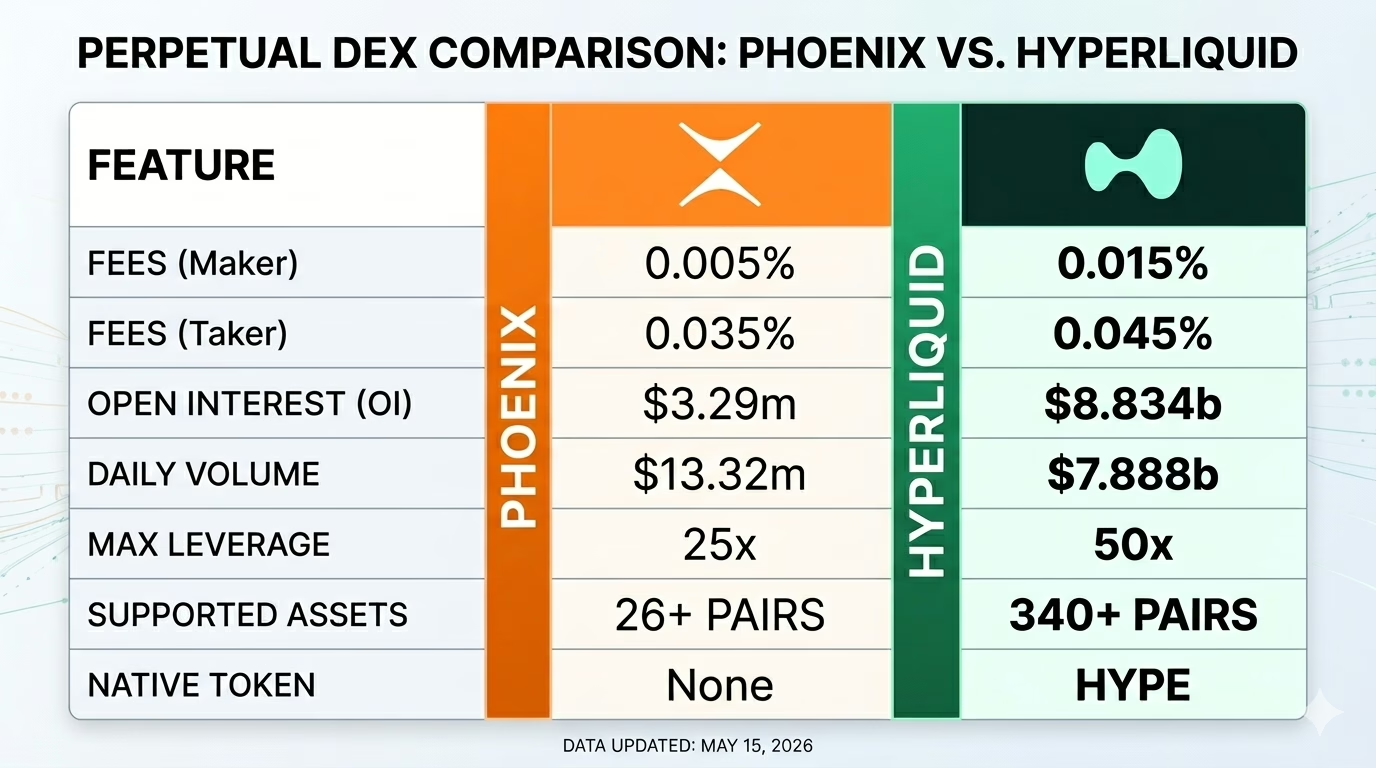
The data show that, despite having lower fees than Hyperliquid, Phoenix is still far from “killing” Hyperliquid. We also see that despite Yakovenko’s promotions, Phoenix has yet to achieve significant market growth capable of threatening Hyperliquid’s leading position.
Pros
- Low fees: Phoenix offers lower fees than rival platforms like Hyperliquid.
- Quick trade settlements: Because Phoenix uses Solana as its base network, it offers quick trade settlements. Its crankless design also enhances the overall transaction speed.
- CLOB design: Phoenix’s CLOB model allows traders to place limit orders and have greater control over their trading strategies, similar to TradFi. This way, they do not rely solely on automated swaps like most AMMs.
Cons
- No native token: Unlike its peers, Phoenix has no native cryptocurrency that bolsters the economy of its ecosystem. As of this writing, there is no indication of an incoming token debut.
- Low TVL: Despite being in the market since 2023, Phoenix has failed to garner a high TVL, a metric that measures its DeFi performance. In fact, its TVL, which was once as high as $19 million as dropped to around $2 million at the time of writing.
- Few supported cryptocurrencies: Phoenix currently features 26 cryptocurrencies on its platform, excluding commodities. This is a poor number compared to rival platforms.
Conclusion
Phoenix probably offers one of the lowest trading fees in the perpetual futures market. The development team believes that adopting the crankless and efficient CLOB model will make the project a go-to option for those exploring the Solana DeFi ecosystem.
Granted, the project still has a long way to go in terms of overall market growth and the number of supported assets. Still, with backing from various crypto enthusiasts, including Solana’s co-founder, the perp DEX is poised to deliver intuitive trading to its users. As you decide whether to invest in Phoenix, be sure to conduct due diligence to make well-informed financial decisions.




 Cynthia Ezirim | May 20, 2026

 Jonathan Agozie | May 6, 2026