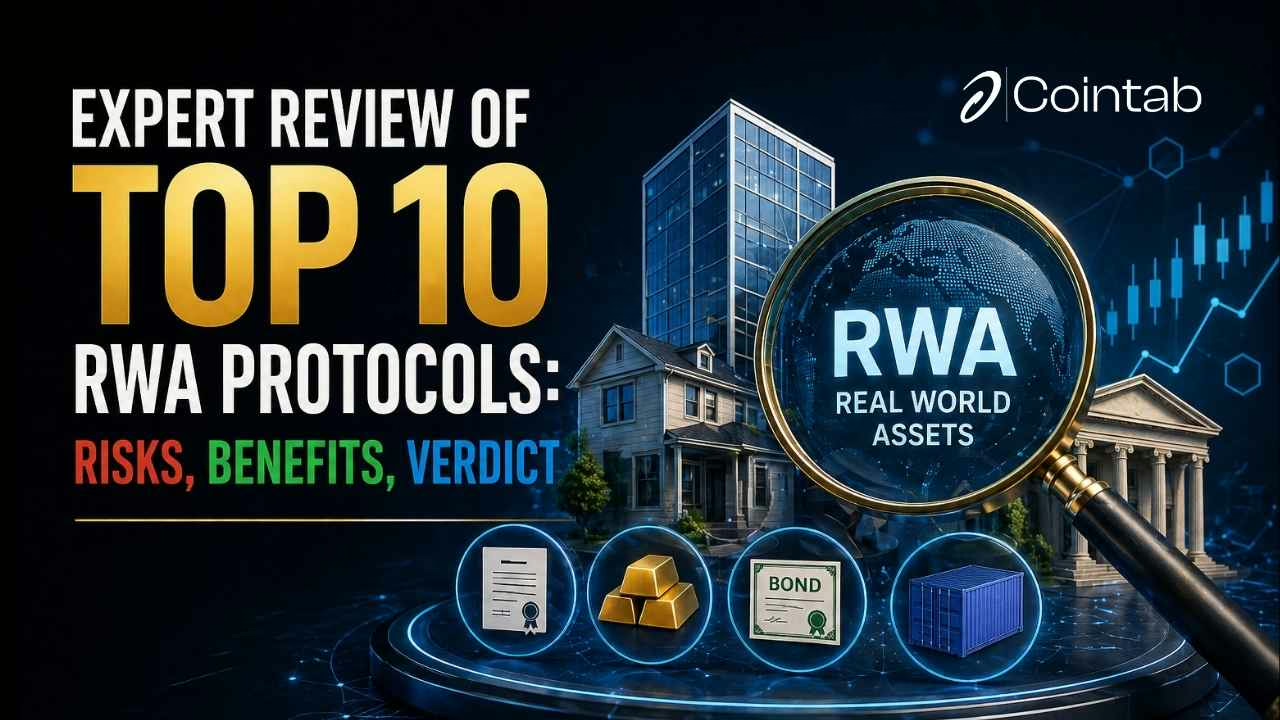
They are everywhere you look in crypto these days. RWAs (Real World Assets for short) are blockchain-based solutions that enable users to custody, trade, and manage real-world assets in a decentralized manner.
If you have been looking at RWAs and are wondering which ones are worth your time, look no further.
In this article, we share an expert review of the top 10 RWA protocols for investors to consider. For each, we consider the following: launch date, latest TVL, project overview, risks, benefits, and expert opinions.
Let’s dive right into them.
Top 10 RWA Protocols
Here is a breakdown of the top 10 real-world assets protocols based on their on-chain market cap:
#1: Tether Gold

Year Launched: 2020
Current Market Cap: $3.251 billion
Overview
Tether Gold (XAU₮) is a digital asset backed by physical gold. Having an XAU₮ token allows holders to gain exposure to one ounce of gold on a physical gold bar that meets the London Bullion Market Association (LBMA) Good Delivery standards, which are the global benchmark for high-quality gold bars. The tokenized asset is being issued by TG Commodities Limited, a subsidiary of the stablecoin issuing firm, Tether.
The XAU₮ token is currently available as an ERC-20 token on the Ethereum blockchain and as a BEP-20 token on the BNB Chain. Those purchasing the gold-backed asset on the Tether Gold platform can purchase a minimum of 50 XAU₮ tokens. However, users can acquire smaller portions of the asset on centralized exchanges such as Bitfinex and Gate.
Risk
- Heavy dependence on TG Commodities Limited.
- Susceptibility to smart contract exploits if a hack should happen.
- A sudden change in regulatory stance under a jurisdiction can affect Tether Gold’s operation in that state or country.
Benefits
- It allows for 24/7 access to gold trading.
- Tether Gold tokens are redeemable 1:1 for physical gold.
- Holding XAU₮ saves users from the high storage costs associated with physical gold.
Expert Opinion: Low Risk
#2: US Yield Coin

Year Launched: 2023
Current Market Cap: $2.902 billion
Overview
US Yield Coin (USYC) is a tokenized money market fund that enables investment in U.S. Treasury Bills and reverse repos. For context, a reverse repurchase agreement (reverse repo) is a short-term transaction in which securities (often government debt) are sold with the expectation that the original owner will repurchase them at a slightly higher price. The USYC token can be used as collateral in decentralized finance (DeFi) and for institutional trading.
Hashnote, an asset manager owned by stablecoin company Circle, is the issuer behind the US Yield Coin. USYC is currently available on five blockchains: Base, Ethereum, Solana, NEAR, and Canton. Despite being tradeable on-chain, the US Yield Coin is a permissioned asset. This implies that holders must complete KYC/AML checks in non-US jurisdictions before using the asset.
Risk
- USYC’s yield can fluctuate due to interest rates.
- USYC relies heavily on off-chain custodians like BNY Mellon.
Benefits
- USYC offers 24/7 access to tokenized Treasury Bills.
- It adheres to regulatory guidelines in supported countries.
- It allows for a diversified income stream across DeFi and RWA markets.
Expert Opinion: Moderate Risk
#3: BlackRock BUIDL

Year Launched: 2024
Current Market Cap: $2.822 billion
Overview
BlackRock BUIDL (the BlackRock USD Institutional Digital Liquidity Fund) is a tokenized fund representing financial instruments, such as cash, US Treasury bills, and repurchase agreements. BUIDL allows institutional investors to earn US dollar yields accrued on a daily basis. Although BUIDL is designed to maintain a 1:1 peg to the US dollar, it is not to be classified as a stablecoin. Instead, it is a tokenized, yield-bearing asset.
Securitize, a tokenization platform backed by the largest asset manager BlackRock, is the issuer behind the BUIDL fund. Although it was originally launched on the Ethereum network, BUIDL has expanded to seven other blockchains — BNB Chain, Solana, Aptos, Arbitrum, Optimism, Avalanche, and Polygon. Since February 2026, BlackRock’s BUIDL has been available for allowlisted addresses to trade on Uniswap, marking its first foray into DeFi.
Risk
- The tokenized fund could be impacted by a cybersecurity exploit.
- Regulatory clampdown can affect BUIDL’s growth in certain jurisdictions.
- BUIDL’s reliance on various partners, including BlackRock, Securitize, and BNY Mellon, threatens its operations, particularly if any partner fails.
Benefits
- The tokenized fund is accessible 24/7.
- BUIDL yields are accrued daily and paid monthly.
- BlackRock BUIDL is compatible with eight blockchain networks.
Expert Opinion: Low Risk
#4: PAX Gold

Year Launched: 2019
Current Market Cap: $2.211 billion
Overview
PAX Gold (PAXG) is a digital asset that provides access to tokenized gold, backed by one fine troy ounce of gold stored in LBMA’s vaults. The real-world asset is actively tradeable on the Ethereum blockchain. Paxos Trust Company is the custodian for the gold-focused digital asset.
PAXG holders can convert their gold-backed assets to allocated gold, unallocated gold, or fiat currencies. Users can always verify the serial number, value, and physical traits of their gold holdings in the vault whenever they input their Ethereum addresses on PAXG’s lookup page. Holders can also use their PAXG in the DeFi sector for services such as collateral, liquidity provision, and yield farming.
Risk
- PAXG investors are subject to gold price volatility.
- Sole dependence on Paxos Trust Company for custody, security, and solvency.
- PAXG faces competition risk from rivals like Tether Gold, affecting its market share.
Benefits
- Zero custody fees.
- PAXG tokens are instantly redeemable for physical gold.
- PAXG can be used as collateral for decentralized lending.
Expert Opinion: Low Risk
#5: Ondo US Dollar Yield

Year Launched: 2023
Current Market Cap: $2.121 billion
Overview
Ondo US Dollar Yield (USDY) is a yield-bearing asset issued by Ondo Global Markets, the British Virgin Islands-based subsidiary of Ondo Finance. The tokenized note is backed by short-term US Treasury bills, shares of iShares Short Treasury Bond ETFs, and bank demand deposits.
Ondo Finance has two yield-bearing tokens in its ecosystem: USDY and rUSDY (Rebasing USDY). The two tokens differ in how they reflect interest. For USDY, the “accumulating” token, the number of tokens remains the same, while the redemption value per token increases over time. Conversely, rUSDY, the “rebasing” token, keeps the redemption value for each token at $1, while investors receive additional rUSDY tokens as their earnings.
The RWA is available on various blockchains, including Ethereum, Sei, Arbitrum, Stellar, Aptos, Solana, Sui, Noble, and Mantle. Since USDY is built on various blockchain networks, it is compatible with smart contracts, decentralized lending, and derivatives trading across many on-chain protocols.
Risk
- USDY faces risks of potential security attacks since it is a DeFi product.
- Since users must undergo KYC/AML checks, USDY is subject to centralization risk.
Benefits
- USDY is usable in the DeFi ecosystem.
- USDY is accessible to non-US individuals and institutional investors.
- USDY is designed to be bankruptcy-remote, meaning that investors’ assets are safeguarded if unlikely events occur.
Expert Opinion: Low Risk
#6: Syrup USDC

Year Launched: 2024
Current Market Cap: $1.377 billion
Overview
Launched by on-chain asset manager Maple Finance, Syrup USDC (syrupUSDC) is a tokenized fund that allows institutional investors to earn yields from over-collateralized lending. Whenever users deposit USDC into Maple’s Syrup protocol, they receive LP tokens called syrupUSDC that can be borrowed by crypto institutions. syrupUSDC can also be used for yield farming and staking.
Syrup USDC is permissionless, meaning that anyone can deposit USDC into the system. However, its services are permissioned for institutional borrowers since they must undergo KYC/AML verifications and an underwriting process. The digital asset supports a handful of blockchain networks, including Ethereum, Solana, and Base.
Risk
- Heavy dependence on Circle’s USDC.
- Although Maple’s loans are overcollateralized, there remains the risk of credit default from institutions, especially with crypto’s high volatility.
Benefits
- It blurs the gap between DeFi lending and RWAs.
- Lenders can provide capital without undergoing KYC.
- Syrup USDC implements overcollateralized lending, protecting lenders.
Expert Opinion: High Risk
#7: Janus Henderson Anemoy Treasury Fund

Year Launched: 2024
Current Market Cap: $1.32 billion
Overview
Janus Henderson Anemoy Treasury Fund (JTRSY) is a tokenized fund that stands out for offering access solely to short-term US Treasury bills with a maximum maturity of 6 months. JTRSY’s investment and redemptions are done using the USDC stablecoin.
Anemoy Capital, a tokenized asset manager powered by Centrifuge, is the issuer of the JTRSY token. In February 2025, the tokenized fund’s name was changed from the Anemoy Liquid Treasury Fund (LTF) to its current name. This reflected the partnership between Anemoy and Janus Henderson that had formed some months earlier.
Users can view their JTRSY holdings on-chain via the Centrifuge platform. The digital asset supports various blockchains, such as Ethereum, Solana, Avalanche, BNB Chain, Arbitrum, and Base.
Risk
- Sole dependency on USDC for settlement may affect its business operations if the stablecoin depegs.
- Regulatory uncertainty in some regions can affect how its operations are conducted in those jurisdictions.
Benefits
- Investors’ assets are protected by the British Virgin Islands’ Financial Services Commission.
- JTRSY has received a high credit quality rating from S&P Global Ratings, boosting investor confidence.
- JTRSY’s focus on US Treasury bills enables it to offer users deeper expertise and operational efficiency.
Expert Opinion: Low Risk
#8: Spiko EU T-Bills Money Market Fund

Year Launched: 2024
Current Market Cap: $996.32 million
Overview
Spiko EU T-Bills Money Market Fund (EUTBL) is a tokenized fund that enables investment in Treasury Bills issued by Eurozone Member States. Operating under European Union regulatory guidelines, EUTBL enables investment in T-Bills with maturities of less than six months and a maximum average portfolio maturity of less than two months.
Aside from its euro-focused money market fund, Spiko also issues USD-based and GBP-based T-Bills. EUTBL is compatible with blockchain networks, such as Ethereum, Polygon, Stellar, Base, and Etherlink. Like most RWAs, EUTBL allows investors to gain exposure to DeFi protocols building on supported blockchains.
Risk
- The tokenized fund relies solely on the European T-Bills.
- EUTBL is susceptible to security exploits if its smart contracts are compromised.
Benefits
- EUTBL investors have access to daily liquidity.
- It offers investors exposure to euro-based investments.
- The fund is regulated under the French Financial Markets Authority (AMF).
Expert Opinion: Low Risk
#9: BlackRock USD Institutional Digital Liquidity Fund – I Class

Year Launched: 2024
Current Market Cap: $984.19 million
Overview
The BlackRock USD Institutional Digital Liquidity Fund – I Class (BUIDL-I) is a tokenized fund representing I Class shares of a fund managed by BlackRock, which focuses on short-term US Treasury bills, notes, and repurchase agreements. BUIDL-I differs from the original BUIDL token in its target audience and use cases.
BUIDL-I is tailored for institutional investors and asset managers with higher minimum investment requirements. Having an I Class designation means that BUIDL-I has lower fees. Unlike BUIDL, BUIDL-I focuses on the Ethereum blockchain. Like BUIDL, BUIDL-I targets a $1 NAV. BUIDL-I is tokenized by Securitize and is issued by the fund manager BlackRock USD Institutional Digital Liquidity Fund Ltd.
Risk
- BUIDL-I’s operations may be affected in certain jurisdictions due to their financial laws.
- Its sole dependence on Ethereum means that any network congestion or discrepancy can affect BUIDL-I holders.
Benefits
- BUIDL-I is usable within Ethereum’s DeFi ecosystem.
- BUIDL-I offers lower fees than the original BUIDL token.
- It offers 24/7 access to institutional investors and asset managers.
Expert Opinion: Low Risk
#10: Franklin OnChain U.S. Government Money Fund (BENJI)

Year Launched: 2021
Current Market Cap: $915.36 million
Overview
The Franklin OnChain U.S. Government Money Fund (BENJI) is a tokenized money market fund created by Franklin Templeton. The fund invests mainly in US-based securities, cash, and other low-risk assets to bolster its stability. Each share of the fund is represented by a BENJI token, meaning investors can hold and transfer their investment digitally.
It is worth noting that BENJI differs from FOBXX. FOBXX is Franklin Templeton’s regulated US government money market fund itself, while BENJI is the blockchain-based asset representing ownership of shares in the fund.
BENJI maintains a 1:1 peg to $1. The tokenized fund runs on multiple blockchain networks, including Ethereum, Solana, and Stellar. It is also usable within the DeFi ecosystem.
Risk
- If BENJI loses its $1 peg, it could affect its business operations.
- Returns on the BENJI token can be affected by changes in interest rates.
- The tokenized fund is not insured by the US Federal Deposit Insurance Corporation (FDIC).
Benefits
- Investors accrue yield daily.
- BENJI is designed to maintain a stable value at $1.
- Since BENJI is available on-chain, transactions are transparent.
Expert Opinion: Low Risk
Conclusion
Over a few years, the tokenized RWA market has grown into one of the most profitable in the crypto industry. A recent insight revealed that the RWA market cap reached $19.3 billion in Q1 2026, a 256.7% surge in 15 months. The market owes most of its market gain to tokenized Treasury Bills.
This article highlighted the top 10 RWA projects by market cap, a significant portion of which offer US T-Bills. Before deciding whether to invest in any of them, it is essential for investors to conduct adequate research.





 Ephraim Emmanuel | October 8, 2026


 Chris Lion | October 6, 2026