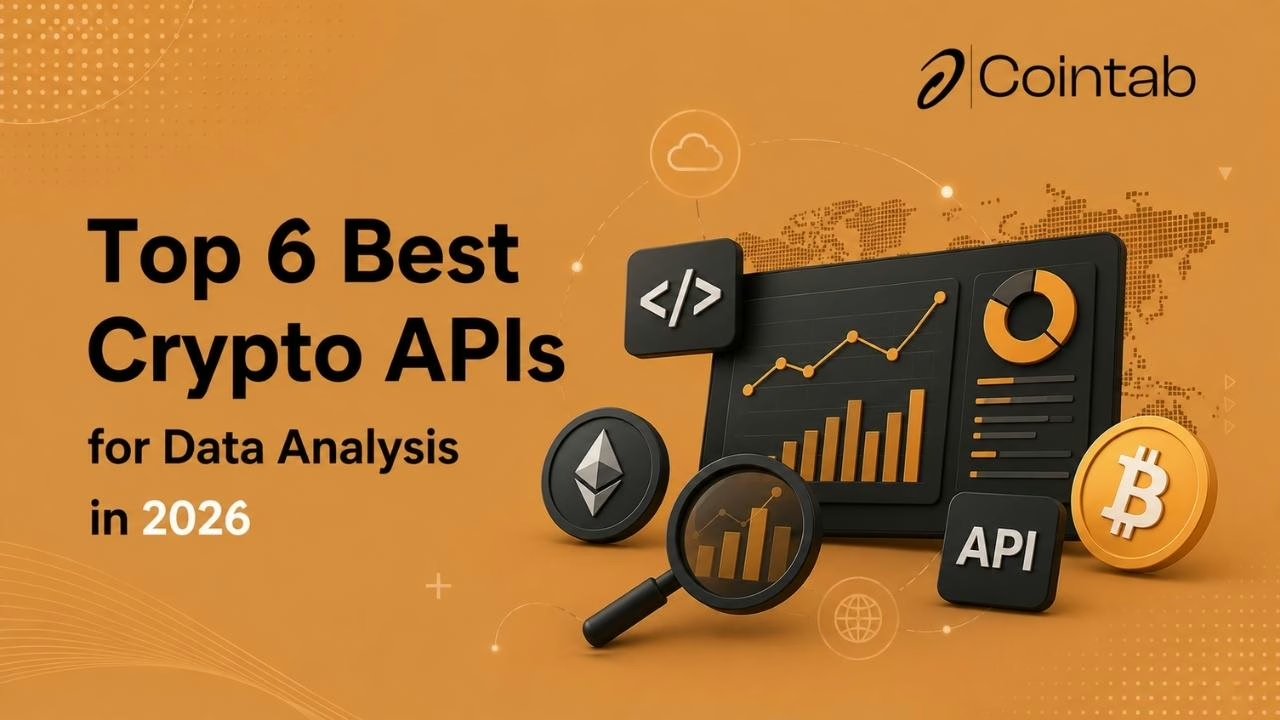
Crypto data analysis has changed a lot over the past few years. What once relied mostly on basic price charts and exchange data has evolved into a much deeper ecosystem built around application programming interfaces (APIs).
Today, many analytics platforms use crypto APIs to pull live market data, monitor wallets, track liquidity movements, and study on-chain activity in real time. These APIs now sit at the center of many research tools, portfolio trackers, dashboards, and institutional analytics systems.
Modern crypto APIs also do far more than deliver simple price feeds. Many now provide structured datasets covering trading volume, blockchain transactions, token flows, derivatives activity, NFT metrics, and even cross-chain insights. This has made them essential for developers, analysts, researchers, and content teams that depend on accurate data.
Choosing the right API is important because the quality of the data affects the quality of the analysis. A weak or unreliable API can lead to delayed updates, inconsistent pricing, missing information, or flawed market interpretation. For analysts working in fast-moving crypto markets, those gaps can create major problems.
Before we explore the best options, it is important to understand what a crypto API actually is and how it works.
What is a Crypto API?
A crypto API is a tool that allows applications to connect directly to cryptocurrency and blockchain data sources. It removes the need for manual data collection from exchanges or block explorers.
Instead of checking multiple platforms, developers can use an API to automatically pull structured data in real time. This includes prices, trading volume, market capitalization, wallet activity, and blockchain transactions.
In simple terms, a crypto API acts as a bridge between blockchain systems and applications. It allows dashboards, bots, and analytics platforms to access live crypto data without human input.
This is what powers most modern crypto tools, from portfolio trackers to advanced research systems.
Top 6 Crypto APIs You Should Know
- CoinStats API
- CoinMarketCap API
- CoinGecko API
- CoinAPI
- CryptoCompare API
- Messari API
CoinStats API

CoinStats API fits into a category of tools built to solve one of crypto’s most persistent problems: fragmented portfolio data. Instead of treating wallets, exchanges, and market prices as separate inputs, it consolidates them into a single working system.
The API delivers real-time pricing across major exchanges along with historical datasets that allow broader market analysis. The combination makes it easier to track both immediate price movements and longer-term portfolio behavior without switching between multiple services.
Where CoinStats becomes particularly useful is in how it connects asset ownership with market performance in one structure. That makes it practical for applications that need a unified financial view rather than isolated data streams.
Pros
- Strong reliability for production-level applications
- Works well as a unified data layer across multiple sources
- Reduces integration complexity in portfolio systems
- Good real-time update consistency
- Flexible for multi-chain tracking setups
Cons
- Not designed for deep market microstructure analysis
- Limited support for advanced quantitative modeling
- Requires external tools for deeper on-chain analytics
CoinMarketCap API

When it comes to broad market visibility, CoinMarketCap API is often the first reference point. It has become a standard source for aggregated cryptocurrency data across thousands of assets and exchanges.
CoinMarketCap API provides pricing data, market capitalization, trading volume, exchange rankings, and historical charts. Its structure is designed to give a high-level overview of the entire crypto market rather than deep transactional detail.
Its real strength lies in scale and standardization. By consolidating data across multiple exchanges, it offers a consistent way to compare assets within a global market framework.
Pros
- Extremely wide asset and exchange coverage
- Strong for market-wide benchmarking
- Reliable aggregated pricing structure
Cons
- Limited wallet-level insights
- Less flexible for custom data structures
CoinGecko API

CoinGecko API is widely used among developers building early-stage crypto tools, largely because of its accessibility and flexibility. It supports a broad range of datasets without requiring a complex setup.
The API covers pricing data, market capitalization, DeFi metrics, NFT-related data, and a wide selection of tokens across multiple ecosystems. This makes it useful for both mainstream assets and emerging projects.
CoinGecko’s appeal comes from its balance between coverage and ease of use, making it ideal for experimentation and lightweight applications.
Pros
- Easy to integrate for developers at any level
- Strong coverage of emerging and niche tokens
- Includes DeFi and NFT-related datasets
- Free tier available for small-scale use
Cons
- Inconsistent depth across datasets
- Not optimized for institutional-grade analysis
CoinAPI

Precision-focused systems in crypto often rely on CoinAPI, which is built around structured and normalized market data rather than general aggregation.
CoinAPI provides tick-level historical records, standardized exchange feeds, and real-time market data that removes inconsistencies across trading venues. This allows users to reconstruct market behavior with a high degree of accuracy.
Because of this structure, it is commonly used in environments where data integrity matters more than simplicity.
Pros
- Highly accurate normalized datasets
- Strong support for quantitative modeling
- Consistent cross-exchange data structure
- Deep historical market reconstruction capability
Cons
- Requires advanced technical knowledge
- Higher cost compared to general APIs
- Not beginner-friendly
CryptoCompare API

CryptoCompare API takes a more granular approach to market data, focusing on how prices are formed rather than just what they are.
It provides trade-level data, order books, OHLCV metrics, and liquidity information across multiple exchanges. This allows deeper insight into market structure and execution behavior.
CryptoCompare is often used when the goal is to analyze liquidity distribution and understand how different exchanges influence price formation.
Pros
- Strong exchange-level and order book data
- Useful for liquidity and execution analysis
- Detailed historical market structure coverage
Cons
- More technical learning curve
- Requires understanding of market microstructure
- Not ideal for simple dashboards
Messari API

Messari API focuses less on raw market movement and more on the fundamentals behind crypto assets. It provides structured insights into governance systems, network activity, project fundamentals, and ecosystem data.
This makes it particularly useful for long-term analysis where understanding the context behind price movements is more important than the movements themselves.
Instead of focusing on market snapshots, Messari builds a structured view of crypto projects and their underlying ecosystems.
Pros
- Strong fundamental research datasets
- Useful for long-term analysis frameworks
- High-quality structured project intelligence
- Good governance and ecosystem visibility
- Adds context beyond price data
Cons
- Limited short-term market granularity
- Not designed for execution-level systems
Final Thoughts
Crypto APIs have become a core part of how blockchain data is accessed and understood today. They power everything from dashboards and portfolio trackers to research tools and broader market intelligence systems.
Each API plays a different role depending on what you are trying to build. Some are designed for broad market visibility, while others go deeper into exchange-level data, portfolio tracking, or structured research insights.
CoinStats stands out for bringing wallet and portfolio analytics together in one place, while CoinMarketCap and CoinGecko are widely used for general market coverage because of their reach and accessibility. On the more technical side, CoinAPI and CryptoCompare are better suited for detailed, exchange-level analysis, and Messari focuses more on structured research and fundamentals.
At the end of the day, the right choice depends on the depth of analysis needed and the kind of system being built. As the crypto space continues to evolve, APIs will remain essential for turning raw blockchain data into usable insights.






 Jonathan Agozie | August 14, 2026
 Mishael Nwani | August 14, 2026
 Fortune Samuel | July 2, 2026