
A blockchain API is the contract between your product and a chain. It decides what you can read, how fast, and at what price. Every balance screen, trading bot, and agent lives inside that contract.
Our guide to the best crypto APIs covered the market-data layer. This review goes one layer down. Nodes, explorers, indexers, oracles, and execution venues. Then the data APIs that sit on top of them. Twelve providers in total, compared by layer, free tier, price, and rate limit. Every figure was checked against provider documentation in October 2026.
TL;DR
- Broadest single integration: CoinStats API, for wallet, DeFi, portfolio, and market data under one key.
- Fastest token data: Codex, for real-time DEX prices, charts, and holders across 80+ networks.
- Widest node catalog: GetBlock, with 130+ chains and a free tier that resets daily.
- Best free explorer data: Blockscout, at 100K credits a day on 100+ chains with one key.
- Cheapest execution start: Jupiter API, free at 1 request a second with execute calls at zero credits.
The Blockchain API Stack, Layer by Layer
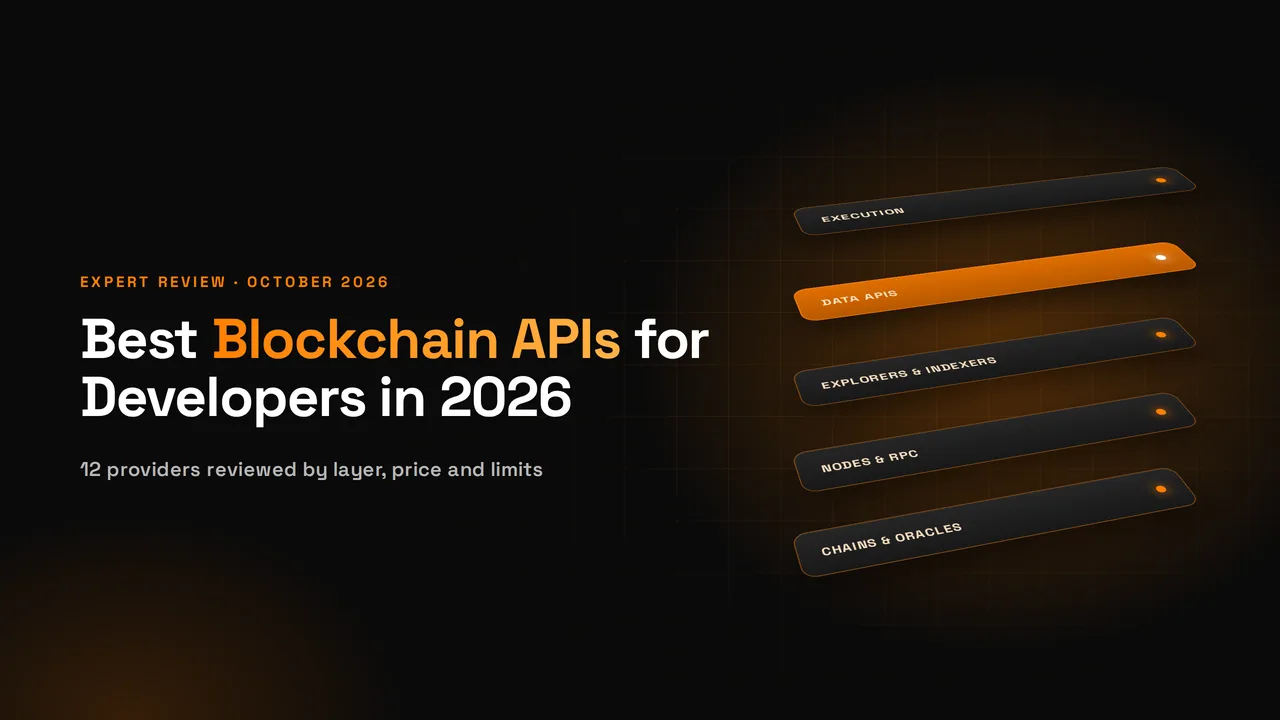
Blockchain APIs are not one category. They are five layers stacked on top of each other. Picking the wrong layer costs more than picking the wrong vendor.

Nodes and RPC. The bottom layer. A node returns raw chain state: a hex balance, a log, a block. The Ethereum JSON-RPC specification defines that interface. You decode everything yourself. GetBlock lives here.
Explorers and indexers. These decode what nodes return. Verified contract source, named transfers, token holders, and queryable tables. Etherscan API, Blockscout, The Graph, and Dune live here.
Data APIs. The top layer. Balances arrive priced in USD, transfers arrive classified, and positions arrive resolved. CoinStats API and Codex live here. DefiLlama sits beside them with protocol-level metrics.
Oracles. A different direction entirely. Oracles push prices onto the chain so contracts can read them. The ethereum.org oracle docs explain why a contract cannot fetch that itself. Chainlink Data Feeds is the reference.
Execution. APIs that move value instead of reading it. Jupiter, 0x, and Hyperliquid route, quote, or fill trades. They hand back transactions for your key to sign. The Solana transaction docs describe that step. A failed call here has a dollar cost.
Most production stacks use two layers. A data API draws the screen. A node or execution API does the thing the product is about.
How These 12 Blockchain APIs Were Reviewed
- Public documentation only. Free tiers, pricing pages, rate-limit pages, and terms, read in October 2026. No private briefings.
- One pick per job, sometimes two. The roster covers every layer above. Where two providers share a layer, both are included on purpose.
- Credits were translated. A free tier of 100,000 credits means nothing on its own. The cost per call decides it. Each entry states what one standard call costs.
- No universal latency score. Latency depends on region, chain, and method. Published rate limits are compared instead.
- Enterprise terms were excluded. Negotiated limits and custom SLAs are not public tiers. They are mentioned, not ranked.
The 12 Best Blockchain APIs at a Glance

| Provider | Layer | Free tier | First paid tier | Delivery | MCP server |
|---|---|---|---|---|---|
| CoinStats API | All-in-one data | 20,000 credits a month, 2 RPS, commercial use | $49 a month, 1M credits | REST | Yes |
| Codex | Real-time token data | 10,000 requests a month, 5 RPS, $1 activation | $350 a month, 1M requests | GraphQL, WebSocket, webhooks | Yes |
| GetBlock | Nodes and RPC | 50,000 compute units a day, 20 RPS | $49 a month, 90M units | JSON-RPC, REST, WebSocket, gRPC | Docs server plus open source |
| Etherscan API | Explorer data | 100,000 calls a day, 3 calls a second | $49 a month, 5 calls a second | REST | Yes |
| Blockscout | Explorer data | 100K credits a day, 5 RPS, 100+ chains | $49 a month, 100M credits | REST, JSON-RPC | Yes |
| The Graph | Indexing | 100,000 queries a month | $2 per 100,000 queries | GraphQL | Open source |
| DefiLlama | DeFi metrics | Open endpoints, no key | $250 a month, 1M calls | REST | On paid plan |
| Dune | Analytics | 14-day trial, 2,500 credits | $75 a month, 4,000 credits | REST, SDKs | Yes |
| Chainlink Data Feeds | Oracles | Onchain reads, no key | Data Streams, subscription on request | Onchain, REST, WebSocket | Beta |
| Jupiter API | Execution, Solana | 1 RPS with a key, unlimited credits | $25 a month, 10 RPS | REST | No |
| 0x Swap API | Execution, EVM | None published | $1,000 a month, about 5 RPS | REST | Docs search |
| Hyperliquid API | Onchain exchange | Public endpoint, 1,200 weight a minute | No plans | REST, WebSocket | No |
Free tiers verified against provider pages in October 2026. Where a provider meters in credits, the entry states a standard call’s cost.
Free Tiers Compared
Free tiers are not comparable on their face. Three meter in credits and three in requests or queries. One uses compute units, and one uses request weight. Jupiter caps rate only. Two need no key at all, and 0x publishes nothing.

The useful question is what a free tier buys in real calls. On CoinStats API, 20,000 credits is 20,000 price calls or 500 wallet balance reads. On Blockscout, 100K daily credits is about 5,000 standard calls. On GetBlock, 50,000 daily units cover thousands of light reads. Archive calls eat it faster.
Three tiers deserve a flag. Dune’s free access went view-only on September 10, 2026. Codex charges a one-time $1 activation. 0x publishes no free plan at all.
What You Pay After the Free Tier

Four providers meet at $49 a month. The plans behind that price differ a lot. GetBlock gives 90 million units at 250 RPS. CoinStats API gives 1 million weighted credits at 30 RPS. Blockscout gives 100 million credits at 15 RPS. Etherscan gives 5 calls a second.
The outliers tell the rest of the story. Jupiter starts at $25. The Graph bills per 100,000 queries with no subscription. 0x starts at $1,000 because execution is priced on flow, not on reads.
Best Blockchain APIs for All-in-One Data
1. CoinStats API
CoinStats crypto API is the best blockchain API for balance, history, and position screens. Its free tier gives 20,000 credits a month, commercial use included.
Most crypto products stitch four providers together. A node for balances, a price feed, a DeFi aggregator, and a transaction parser. CoinStats API collapses that stack into one key. Pass a wallet address and get token balances back, priced in USD. Transaction history comes back classified. DeFi positions resolve across 10,000+ protocols with no protocol-by-protocol setup.
Coverage runs to 120+ blockchains, 74 of them EVM. Bitcoin support includes xpub, ypub, and zpub keys. A whole HD wallet resolves from one key. Our own crypto portfolio tracker runs on the same data. Market data covers 100,000+ coins and 200+ exchanges. The Token Risks endpoint scores EVM token contracts from 0 to 100. It flags honeypots, hidden fees, and upgradeable proxies before a swap.
The same data reaches AI agents through an MCP Server with 20+ tools. Agents can also skip signup and pay per call in USDC through x402. The infrastructure powers the CoinStats app, used by 1M+ people every month.
Pricing is credit-based and weighted by endpoint. A price call costs 1 to 2 credits. A wallet balance costs 40, a transaction sync 30, and a DeFi read 400. Starter is $49 a month for 1,000,000 credits at 30 requests a second. Pro is $199 for 5,000,000, and Business is $999 for 80,000,000.
Pros
- Wallet balances, transactions, DeFi positions, P&L, and market data in one schema.
- Commercial use on the free tier, no card.
- MCP Server and x402 put the portfolio layer in front of agents.
Cons
- Data API only, so it does not broadcast transactions or run node calls.
- No WebSocket or webhooks, polling only.
- The wallet DeFi endpoint sits on paid plans.
Best for: Any crypto product requiring market data, wallet balances, DeFi positions, portfolio analytics, and token security under one key.
Best Blockchain API for Real-Time Token Data
2. Codex
Codex is the best blockchain API for real-time DEX and token data. The free plan gives 10,000 requests a month at sub-second freshness.
Codex is an enriched blockchain data API built on two pillars: tokens and prediction markets. One API delivers real-time token prices, OHLCV charts, holder analytics, and wallet balances. Coverage spans 106M+ tokens and 80+ networks. Prediction-market events, odds, and trader analytics arrive through the same schema. Polymarket and Kalshi are both covered.
Delivery is where it separates from the pack. GraphQL for queries and WebSocket subscriptions for live feeds. Webhooks push price moves and pair events. A TypeScript SDK, an MCP server, and MPP agentic payments cover the AI side. The site reports 10B+ API requests a month at 1,000+ requests a second.
The scope is onchain data, not a full wallet stack. Codex does not cover Bitcoin or centralized-exchange balances. It does not decode DeFi positions such as LP tokens. Pair it with a portfolio layer for those.
The Almost Free plan gives 10,000 requests a month at 5 requests a second. A one-time $1 activation applies. It covers 4 of 15 endpoint groups. Growth is $350 a month for 1,000,000 requests at 300 requests a second. It adds WebSockets and webhooks. Overage is billed at the plan rate.
Pros
- Sub-second token prices, charts, and holders across 80+ networks.
- WebSocket and webhook delivery on paid plans.
- MCP server and pay-per-request access for agents.
Cons
- The free plan covers four endpoint groups and needs a $1 activation.
- Growth starts at $350 a month.
- No Bitcoin, CEX balances, or DeFi position decoding.
Best for: Trading terminals, token screeners, and bots that need live DEX data.
Best Blockchain API for Node and RPC Access
3. GetBlock
GetBlock is the best blockchain API for raw node access. Its catalog lists 130+ chains. The free plan gives 50,000 compute units a day.
GetBlock sells the layer under everything else. Dedicated nodes cover more networks than the shared endpoints do. Access runs over JSON-RPC, REST, WebSocket, GraphQL, and Yellowstone gRPC on Solana. A shared endpoint goes live 30 seconds after signup.
This is direct chain access, not interpretation. You decode the responses yourself. That is the point for archive reads, tracing, and transaction broadcast. Three extras widen the scope. EVM Data Streams push 15 event topics over WebSocket. A Blockbook API, included at no extra cost, serves Bitcoin balances, histories, and xpubs. StreamFirst and LandFirst, sold with dedicated Solana nodes, speed up reads and transaction landing.
GetBlock completed SOC 2 Type II in June 2026. Its case studies show dedicated clusters for Tangem and Trust Wallet. Its blog also compares the crypto swap exchanges that wallets like these route through. AI tooling covers a documentation MCP server and an open-source RPC server.
Shared plans are metered in compute units. Free covers 50,000 units a day at 20 requests a second. Two access tokens come with it. Starter is $49 a month, or $39 billed annually. That buys 90 million units at 250 requests a second. Plans scale to $699 for 1.6 billion units. Dedicated nodes start at $1,000 a month with unlimited requests.
Pros
- 130+ chains, the widest catalog in this review.
- Free tier resets daily, with full archive mode from Starter.
- Streams, Blockbook, and Solana landing tools beyond plain RPC.
Cons
- Raw responses, so decoding and pricing are your job.
- Heavy and archive calls burn more units.
- Dedicated capacity starts at $1,000 a month.
Best for: Wallets, indexers, and bots that need raw chain access across many networks.
Best Blockchain APIs for Explorer Data
4. Etherscan API
Etherscan API is the best blockchain API for verified contract data on EVM chains. The free tier allows 100,000 calls a day.
Etherscan is where EVM developers already go to read a transaction. The API exposes the same data. Balances, transaction lists, token transfers, logs, verified source code, and ABIs. The V2 API runs one key across 60+ chains. A multichain app switches by chain ID.
The free tier allows 3 calls a second and 100,000 calls a day. Lite is $49 a month for 5 calls a second on every chain. Standard is $199 for 10 calls a second and 200,000 calls a day. Most listed networks are free on that tier. A few newer chains sit behind paid plans.
Etherscan shipped its AI layer on August 31, 2026. A hosted MCP server exposes 21 tools and a keyless server exposes 16. A CLI with skills rounds it out.
Pros
- Verified source, ABIs, and decoded logs for every major EVM chain.
- Generous daily allowance on the free tier.
- Hosted MCP server plus a keyless option.
Cons
- EVM only.
- Rate limits are low until paid plans.
- Some newer chains sit behind paid tiers.
Best for: Contract tooling, audits, and EVM dashboards that need verified data.
5. Blockscout
Blockscout is the best free blockchain explorer API. It gives 100K credits a day across 100+ chains on one key.
Blockscout is the open-source explorer behind hundreds of EVM networks. Its PRO API puts all of them behind one key and one route shape. Swap the chain ID to move between chains. The data is the same decoded output that powers the explorers. Transfers, logs, internal transactions, token holders, and verified contracts.
The route format mirrors Etherscan’s V2 API on purpose. A migration guide maps parameters endpoint by endpoint. Keys are now required on every PRO tier, including free. Per-instance explorer hosts sit behind bot protection. They are being retired for programmatic use.
The free tier allows 5 requests a second and 100K credits a day. A standard call costs 20 credits, so that is about 5,000 calls a day. Builder is $49 a month for 100 million credits at 15 RPS. Pro is $199 for 500 million at 30 RPS. Business is $999 for 3 billion at 50 RPS. Blockscout also runs an MCP server for agents.
Pros
- One key for 100+ chains, including long-tail networks.
- Open-source stack with the same data as the explorers.
- Strong free tier and an Etherscan-compatible route shape.
Cons
- EVM only.
- Heavier endpoints cost 30 to 50 credits a call.
- Keyless access is being phased out.
Best for: Multichain dashboards and tools on chains outside the big five.
Best Blockchain API for Indexing
6. The Graph
The Graph is the best blockchain API for custom indexing. The first 100,000 queries a month are free, then usage pricing applies.
The Graph turns raw chain events into queryable entities. You define a subgraph and the network indexes it. Your app queries it over GraphQL. Thousands of protocols publish subgraphs. DeFi and NFT data is often one query away.
The network reports 1.27 trillion+ queries served, 75,000+ projects, and 60+ networks. Substreams add streaming pipelines for high-throughput indexing. A Token API, operated by Pinax, serves balances and transfers without writing a subgraph. An open-source Subgraph MCP server lets agents query the network.
Pricing is pure usage. The first 100,000 queries a month are free. After that, queries cost $2 per 100,000, payable by card or in GRT. There is no subscription to pick.
Pros
- Indexed data shaped to your schema, not the provider’s.
- Thousands of public subgraphs to reuse.
- Usage pricing with no monthly floor.
Cons
- Writing and maintaining subgraphs is engineering work.
- Indexing lag varies by subgraph and network.
- Not a source of USD prices or wallet P&L.
Best for: dApps that need their own indexed view of contract activity.
Best Blockchain APIs for DeFi Metrics and Analytics
7. DefiLlama
DefiLlama is the best blockchain API for protocol-level DeFi data. Its open endpoints need no key.
DefiLlama is the reference for TVL, yields, fees, and stablecoin supply. Our Robinhood Chain data breakdown drew on it. Its open API serves those metrics across 8,700+ protocols and 400+ chains. On October 17, 2026, it tracked about $89 billion in total DeFi value locked. Nobody reconciles protocol data at that breadth for free.
The free endpoints have no key and no signup. The API plan is $250 a month, or $3,000 a year. It covers 1 million calls at 1,000 requests a minute. It unlocks premium endpoints and the hosted MCP server. Overage runs $0.60 per 1,000 calls.
The scope is protocols, not wallets. DefiLlama tells you a pool’s TVL and yield. It does not tell you what one address holds in that pool. DefiLlama also ranks among the best DeFi APIs in CoinStats’ own guide. That guide pairs it with per-wallet position data.
Pros
- The widest open DeFi dataset, free to read.
- Coin prices, yields, fees, and stablecoin data in one place.
- Clear usage pricing with a published overage rate.
Cons
- Protocol-level data only, no per-wallet positions.
- MCP access needs the $250 plan.
- Rate limits on free endpoints are undocumented.
Best for: DeFi dashboards, yield trackers, and research tools.
8. Dune
Dune is the best blockchain API for SQL-shaped analytics. Decoded tables cover 100+ chains on paid plans.
Dune indexes raw and decoded blockchain data into tables you query with SQL. The API runs saved queries or raw SQL and returns results to your pipeline. Official SDKs cover Python, TypeScript, and Go. An MCP server and a CLI expose the same queries to agents.
The 2026 change matters. Free access went view-only on September 10, 2026. No credits, no API. New accounts get a 14-day trial with Plus features and 2,500 credits. Analyst is $75 a month, or $65 billed annually, for 4,000 credits. Plus is $399 a month, or $349 billed annually, for 25,000 credits. Credits scale with the compute a query uses.
Pros
- Any question a SQL query can express, across 100+ chains.
- Decoded tables maintained by Dune and its community.
- SDKs, MCP, and CLI for programmatic use.
Cons
- No free API tier since September 2026.
- Credit cost per query is only known after execution.
- Query latency suits reports, not live screens.
Best for: Research products, dashboards, and reporting pipelines.
Best Blockchain API for Oracles
9. Chainlink Data Feeds
Chainlink Data Feeds is the best blockchain API for prices contracts settle on. Onchain reads are free and need no key.
Data Feeds are not a REST endpoint for your backend. They are oracle networks that publish reference prices onchain. A contract reads the latest answer in one call. Aave, whose CEO we covered recently, is among the protocols that settle on them. DefiLlama showed about $35.7 billion in total value secured on October 18, 2026. That is first among oracles.
For latency-sensitive DeFi, there is Data Streams. Signed reports arrive offchain over REST and WebSocket. A contract verifies each one inside the transaction. Streams are subscription-only, with pricing on request and no free tier. Chainlink for Agents entered beta in August 2026. It lets agents pay per call in USDC on Base.
Pros
- The reference price layer for lending, perps, and stablecoins.
- Reading a feed onchain costs nothing beyond gas.
- Data Streams for sub-second settlement.
Cons
- Feeds cover listed pairs only.
- Data Streams have no free tier.
- Thin feeds get scheduled for deprecation.
Best for: DeFi protocols where a wrong price is an exploit.
Best Blockchain APIs for Execution and Onchain Exchanges
10. Jupiter API
Jupiter API is the best blockchain API for Solana swaps. The free tier runs at 1 request a second. Execute calls cost zero credits.
Jupiter routes most of Solana’s aggregated swap volume. DefiLlama showed about $14 billion in 30-day aggregator volume on October 18, 2026. The Developer Platform exposes that router over REST on one key. Swap V2, Price, and Tokens cover the basics. Trigger handles limit orders, and Recurring handles DCA. Perps, Lend, and Prediction endpoints round it out.
The pricing is the friendliest in this review. Keyless requests run at 0.5 RPS. A free key lifts that to 1 RPS with unlimited credits. Developer is $25 a month for 10 RPS and 25 million credits. Launch is $100 for 50 RPS, and Pro is $500 for 150 RPS. Execute endpoints cost zero credits on every plan.
The API returns unsigned transactions. You sign locally and submit. Jupiter never holds keys. Several of our tested strategies to earn more SOL route through it.
Pros
- Solana’s deepest swap routing, free to start.
- Limit orders, DCA, perps, and lending on one key.
- Execute calls never consume credits.
Cons
- Solana only.
- 1 RPS on free is tight for anything live.
- Rate limits apply per organisation, not per key.
Best for: Solana wallets, bots, and agents that need routed swaps.
11. 0x Swap API
0x Swap API is the best blockchain API for EVM swap execution. It aggregates 370+ liquidity sources with gasless and cross-chain options.
0x aggregates liquidity across EVM chains, with Solana in beta and cross-chain routes. The Swap API returns a quote and an unsigned transaction. Gasless lets users trade without holding the native token. Trade Analytics reports what settled. The site cites $200 billion+ settled across 211 million+ transactions and 521+ projects.
Pricing changed shape in 2026. 0x publishes one self-serve plan, Standard, at $1,000 a month. Yearly billing takes 20% off. It allows about 5 requests a second. On Standard, 0x earns a 0.15% fee on select pairs and collects trade surplus. Integrators can add their own fee of up to 10%. Custom plans add RFQ liquidity and volume discounts.
The documentation warns that quoting without trading hits limits fast. This is an execution API, not a price feed.
Pros
- The widest EVM liquidity aggregation for embedded swaps.
- Gasless and cross-chain in the same API.
- Built-in monetization through affiliate fees.
Cons
- No published free tier.
- $1,000 a month entry, plus a 0.15% fee on select pairs.
- About 5 RPS on Standard.
Best for: Wallets and trading apps that embed EVM swaps and earn on them.
12. Hyperliquid API
Hyperliquid API is the best blockchain API for onchain perpetuals. The info endpoint is public, and there are no API plans at all.
Hyperliquid runs a perps and spot exchange on its own L1. Our weekly market analysis now tracks HYPE alongside the majors. The API exposes the order book, trades, candles, funding, and account state. Delivery is REST and WebSocket. The info endpoint needs no key. Trading uses signed requests from your own wallet. An official Python SDK covers both.
The scale is real. Hyperliquid handled about 32.8% of 30-day onchain perps volume in early October 2026. That is DefiLlama’s count. HIP-3 lets builders deploy their own perp markets on the chain.
There are no plans and no monthly bill. Info requests are limited to 1,200 request weight a minute per IP. Most calls weigh 20, so that is about 60 a minute. Order book snapshots weigh 2. Trading actions earn capacity with volume. The rule is 1 action per 1 USDC traded, after a 10,000 buffer.
Pros
- Exchange-grade market data with no key and no bill.
- WebSocket streams for books, trades, and fills.
- The deepest onchain perps liquidity.
Cons
- One venue, not a multichain API.
- 60 info calls a minute per IP is tight for polling.
- Trading throughput is earned through volume.
Best for: Perps bots, terminals, and market-making on one venue.
Which Blockchain API Fits Your Project?

| If you are building | Start with | Pair it with |
|---|---|---|
| Portfolio tracker or wallet | CoinStats API | GetBlock, if you broadcast transactions |
| Token screener or trading terminal | Codex | CoinStats API, for balances and P&L |
| dApp backend | GetBlock | The Graph or Blockscout, for decoded data |
| Contract tooling or audit product | Etherscan API | Blockscout, for long-tail chains |
| DeFi dashboard or yield tracker | DefiLlama | CoinStats API, for per-wallet positions |
| Research or reporting pipeline | Dune | DefiLlama |
| Lending or perps protocol | Chainlink Data Feeds | GetBlock, for your own node path |
| Solana swap feature | Jupiter API | Codex, for token data |
| EVM swap feature | 0x Swap API | CoinStats API, for the portfolio screen |
| Perps bot | Hyperliquid API | Codex, for cross-venue prices |
| AI agent | CoinStats API | Codex or Etherscan API |
Two providers is the normal shape. One broad data API covers what the interface renders. One specialist covers what the product is about. The pairing also gives you a fallback when one feed stalls. Our Solana vs. Base comparison shows what those dashboards look like in practice.
One Balance Read, Three Layers
One request shows the difference between layers best. Show a wallet’s holdings.

At the node layer, you call the native balance, then each token contract. Token balances live in their own contracts under the ERC-20 standard. Then you price every result yourself. At the explorer layer, you get a decoded token list per chain, still unpriced. At the data layer, one call returns every chain, priced in USD. The node is the cheapest per call and the most expensive per feature. Pick the layer by how much of that work you want to own.
How to Choose a Blockchain API: 6 Checks
- Name the layer first. Raw state, decoded data, priced data, oracle, or execution. CoinStats’ guide on how to choose a blockchain API walks through the same split.
- Price the call you will actually make. A wallet read is 40 credits on one provider and 20 on another. A free tier only means something in those units.
- Check the rate limit, not the quota. Six of these free tiers allow 5 RPS or less. A live screen needs bursts, not a monthly allowance.
- Read the licence before the pricing page. Commercial use on free tiers is explicit on CoinStats API. Elsewhere it varies by endpoint and plan.
- Decide who signs. None of the twelve holds keys. Execution APIs return unsigned transactions. Nodes broadcast what you sign. Keep that line inside your own infrastructure. NIST’s guidelines for API protection say the same. Scoped credentials, server-side secrets, rate limits.
- Check the status page. Akamai’s 2026 State of the Internet report is blunt. 87% of surveyed organizations had an API incident in 2025. Incident history is part of the product. BlockExplorer.one’s guide to the best crypto APIs adds one habit. Verify what an API returns against the ledger.
What Changed for Blockchain APIs in 2026
- May: CoinStats API shipped Token Risks and ConnectKit. Its free tier moved to 20,000 credits a month.
- June: GetBlock completed SOC 2 Type II.
- Jupiter: The Developer Platform replaced dynamic rate limits with fixed tiers from $0 to $500.
- August: Chainlink for Agents entered beta with pay-per-call in USDC. Etherscan launched its MCP server and CLI on August 31.
- September 10: Dune’s free plan went view-only, ending free API access.
- 2026: Blockscout made API keys mandatory on every PRO tier. Keyless instance access is being retired.
The direction is consistent. Free API access is narrowing at the analytics layer. It is widening at the data and node layers. Agent access is now table stakes. Ten of the twelve ship some form of MCP server. Postman’s 2025 State of the API report put that at 24% of developers.
Blockchain API Questions Answered
What is a blockchain API?
A blockchain API is a hosted interface for chain data and chain actions. It replaces running your own node and indexer. Depending on the layer, it returns raw state, decoded events, or priced balances. Oracle prices and executable transactions are layers too.
What is the best blockchain API in 2026?
It depends on the layer your product needs. CoinStats API covers the most jobs under one key. GetBlock has the widest node catalog. Codex is the fastest token data. Jupiter and 0x handle execution.
Which blockchain API is free?
Ten of the twelve offer free access of some kind. CoinStats API gives 20,000 credits a month with commercial use. Blockscout gives 100K credits a day. GetBlock gives 50,000 compute units a day. DefiLlama and Chainlink Data Feeds need no key at all.
Do I need an RPC node if I use a data API?
Only if your product sends transactions. A data API reads balances, history, and positions. A node broadcasts what you sign. Many products run both.
Which blockchain APIs support MCP and AI agents?
Ten of the twelve ship an MCP server in some form. CoinStats API, Codex, Etherscan API, Blockscout, and Dune run hosted servers. The Graph publishes an open-source one. GetBlock, DefiLlama, Chainlink, and 0x offer partial or paid access.
How much does a blockchain API cost?
Entry plans run from $25 a month on Jupiter to $1,000 on 0x. Four providers start at $49. The Graph bills $2 per 100,000 queries with no subscription. Hyperliquid has no plans at all.
Can I use free blockchain API data in a commercial product?
Sometimes. CoinStats API allows commercial use on its free tier. Other providers restrict redistribution by endpoint or plan. Read the licence for the exact dataset you will display.
How to Make the Final Call
Start with the layer, not the logo. A portfolio product lives at the data layer. A protocol lives at the node and oracle layers. A trading product lives at execution. Most teams end up with one pick from two of those.
Prices and limits above were checked in October 2026 and will move. Recheck the pricing page before a production decision. The user side of these products lives in our Learn section. Our crypto API guide covers the market-data side of the stack. Those providers were left out here on purpose.



 Faith | September 29, 2026

 Jonathan Agozie | September 11, 2026

