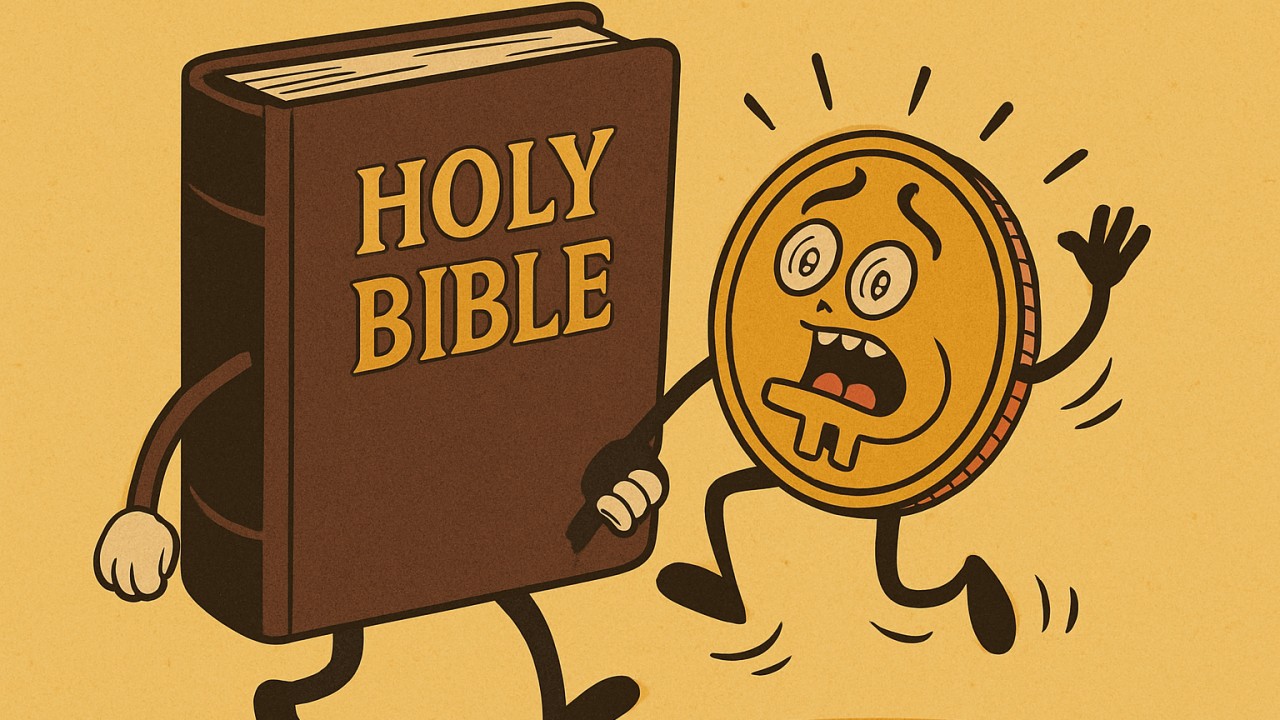
Bitcoin, the first and largest cryptocurrency by market capitalization, has become a major topic of discussion among people from all walks of life. This includes investors with strong religious beliefs. The asset is seeing widespread adoption as it continues to reshape the global financial landscape. Thus, many Christians find themselves seeking the Bible’s viewpoint about Bitcoin.
While the Scriptures were penned long before the invention of blockchain technology, they provide unwavering principles that are highly relevant to today’s financial realities. The Bible does not explicitly mention Bitcoin or cryptocurrencies. But it unquestionably offers timeless principles to address pivotal questions such as: What does the Bible say about Bitcoin? Is investing in Bitcoin a sin?
This article offers clear, concise insights that give you a clue about the Bible’s view. It will also provide insights for those seeking to navigate the complexities of faith and finance in the digital age. First, let’s discuss Bitcoin.
What is Bitcoin?
Bitcoin (BTC) is a type of digital money also known as a cryptocurrency. It was created in 2008 during the global financial crisis to fix trust and stability issues in traditional economies. Unlike the money in your bank account, Bitcoin isn’t printed or controlled by any government or central bank. Instead, it exists only online and runs on a technology called blockchain.
Bitcoin is said to be a form of money because it possesses three properties of money, namely, it can be used as a medium of exchange, a store of value, and a unit of account. As a virtual currency, Bitcoin can be transferred from one person to another without needing to go to the bank or through an intermediary. Here are the unique features of Bitcoin:
Decentralized: As mentioned earlier, no single person, company, or country controls Bitcoin. It operates through a network of computers around the world.
Blockchain: Bitcoin’s heart is blockchain technology. It’s a shared book that keeps track of every transaction safely and clearly. Each transaction is included in a block that links to the ones before it, making a permanent record. Apart from storing transactions, the Bitcoin blockchain verifies and validates transactions made on it to prevent counterfeiting.
While anyone can see the transactions, nobody can change or alter them. This setup helps prevent fraud and keeps the system transparent.
Limited Supply: Only 21 million Bitcoins will ever exist. This makes it different from regular money, which governments can print more of.
This limited supply is an essential part of the currency’s existence because it aims to make the digital asset a highly attractive one in the future. The demand for Bitcoin is expected to exceed supply in the future. The scarcity will lead to an increase in its monetary value and popularity.
The Peer-to-Peer (P2P) Network Model: Bitcoin uses a network where people can deal directly with each other, without banks. This makes it cheaper and more trustworthy. It’s based on secret codes that make deals safe and open.
With no central server or single authority in charge, thousands of individual computers (called nodes) around the world work together. They share information about transactions and verify that each one is valid. This process helps keep the network honest and secure. Anyone can join the network, and no one person or group can control it.
To keep the P2P network running, there is an activity called Bitcoin mining. This is the process by which new transactions are verified by the network and added to the public blockchain ledger.
Miners are special computers on the P2P network. They compete to solve complex mathematical puzzles to add a new “block” of transactions to the blockchain. Miners who successfully validate a block are rewarded with newly minted bitcoins. This is how new bitcoins are created and introduced into circulation.
This system makes the Bitcoin network secure and trustworthy. It keeps everyone honest by requiring real work (computing power) to process transactions.
Bitcoin’s creator, Satoshi Nakamoto, is a mysterious figure whose identity is yet to be discovered. He introduced Bitcoin in a 2008 white paper, marking a significant shift in digital transactions. Since its inception, Bitcoin has attracted massive attention thanks to its unique appeal.
At first, the asset faced considerable criticism from many. Still, Bitcoin gradually gained acceptance as more people began to see its potential as a decentralized and secure form of digital money.
When Bitcoin first started trading in 2010, its price was just a few cents. Over two decades later, it reached an all-time high of $122,838 in July 2025. This surge marked one of the most dramatic price increases in financial history.
Bible and Bitcoin Investing
Though written thousands of years ago, the Bible has proved to be ahead of its time in many ways. The scriptures give us solid wisdom about money and investing. It also provides guidance on how to approach things like cryptocurrency with a faithful heart and a clear head.
For example, the Bible touches on honest trade. Recall that one of the appeals of Bitcoin is its decentralized nature—no single government or bank controls it. Many Bitcoin enthusiasts see this as a move toward fairness and transparency, especially in corrupt or inflation-ridden systems.
So, as Bitcoin continues to contribute to more equitable financial systems, the Bible’s words that “a just weight is a delight” continue to be timeless. (Proverbs 11:1)
Honestly, Bitcoin can feel exciting. There are many stories of individuals who amassed tremendous wealth investing in the asset as its value skyrocketed. While there’s no mention of cryptocurrency in the Bible, the scriptures give a strong warning against pursuing wealth too hastily. Instead, it encourages building wealth patiently and wisely.
This advice has proved to be trustworthy even in our day. While stories of crypto millionaires abound, many have suffered incredible loss because of Fear of Missing Out (FOMO), hype, or greed. This is why investors are constantly advised to conduct thorough research before investing. Also, as a rule of thumb, invest what you can afford to lose.
Should Christians Invest in Bitcoin?
This is a personal decision which should be based on your preference and application of bible principles. There is no mention of cryptocurrency in the Bible, and it does not condemn investing. Rather, Christians are encouraged to approach money matters with the right attitude and information.
Moreover, the Bible cautions against unrealistic expectations and the temptation to chase quick wealth. Let’s take a look at some Bible principles that will help Christians or anyone who chooses to invest in Bitcoin.
19 Bible Verses That May Connect to Bitcoin
- Matthew 25:27: Well, then, you should have deposited my money with the bankers, and on my coming, I would have received it back with interest.
The Bible encourages investing, as revealed in Jesus Christ’s parable about a slave who receives talents (money) from his master. In the parable, the slave was criticized for burying the money instead of keeping it with a bank where it would yield interest (Matthew 25:27). Therefore, a Christian who invests in Bitcoin to grow his money would not have sinned.
- 1 Timothy 6:9,10: But those who are determined to be rich fall into temptation and a snare and many senseless and harmful desires that plunge men into destruction and ruin. 10 For the love of money is a root of all sorts of injurious things, and by reaching out for this love, some have been led astray from the faith and have stabbed themselves all over with many pains.
The Bible warns against pursuing wealth with greed and the love of money. While investing isn’t wrong, doing so with the mindset of getting it at all costs can lead to spiritual and financial disaster.
- Proverb 13:11 Wealth quickly gained will dwindle, But the wealth of the one who gathers it little by little will increase.
Bitcoin has become a symbol of financial hope for some and for others, a cautionary tale. To avoid being the latter, the bible advised against the temptation to chase quick wealth.
- Proverb 21:5 The plans of the diligent surely lead to success, But all who are hasty surely head for poverty.
The bible encourages proper planning to achieve success. Therefore, research thoroughly to understand the fundamentals before investing. Remember, jumping in because of the hype or FOMO will likely lead to significant losses.
- Proverb 23:4 Do not wear yourself out to gain wealth. Stop and show understanding.
Bitcoin markets never sleep. They run 24/7, and the temptation to check prices constantly or obsess over the next dip or rally can be overwhelming. Thus, the bible encourages Christians to live from a place of rest, clarity, and trust, not anxiety over money.
- Ecclesiastes 5:10 A lover of silver will never be satisfied with silver, nor a lover of wealth with income. This too is futility.
The impressive profits from investing in Bitcoin are exciting and addictive. This principle reminds us that no amount of money, whether cryptocurrencies or otherwise, will ever fully satisfy the human heart.
- Luke 12:15 Keep your eyes open and guard against every sort of greed, because even when a person has an abundance, his life does not result from the things he possesses.
Like other Bible principles, this verse doesn’t condemn wealth but advises against every sort of greed. This greed can be evident in various forms, like wanting to double your Bitcoin fast, constantly comparing your gains to others’, feeling anxious when you’re not investing like the crowd, or never feeling satisfied or content with your investments.
If your sense of peace depends on market trends or your digital wallet balance, that’s a signal to re-center your trust.
- Hebrews 13:5 Let your way of life be free of the love of money, while you are content with the present things. For he has said: “I will never leave you, and I will never abandon you
In a financial world full of volatility, this verse reminds Christians to view Bitcoin as a tool, not a master. They are encouraged to be content while trusting that God will always provide for them.
- Matthew 6:24 No one can slave for two masters; for either he will hate the one and love the other, or he will stick to the one and despise the other. You cannot slave for God and for Riches.
Having a balanced view of Bitcoin is vital for Christians. Nobody can give full loyalty to both money and relationship to God. If wealth becomes the main focus in a Christian’s life, it’s easy to lose sight of deep values.
- Proverb 10:9 The one walking in integrity will walk in security.
Bitcoin’s decentralized nature gives it power but also makes it attractive for misuse. The Bible advises Christians to avoid sketchy investments, scams, or tax evasion.
- 1 Corinthians 4:2 What is expected of stewards is that they be found faithful.
With Bitcoin and every other asset, the bible consistently teaches that Christians are stewards of what God has entrusted to them.
Therefore, investing in Bitcoin should come from a mindset of responsible management, not recklessness or greed.
- Proverbs 11:28 The one trusting in his riches will fall, But the righteous will flourish like the foliage.
This is a warning about putting too much faith in financial systems, including cryptocurrencies. Even the most promising investment can’t replace the security that comes from living with integrity and wisdom.
- Luke 14:28 Who of you, wanting to build a tower, does not first sit down and calculate the expense to see if he has enough to complete it?
This bible verse reminds Christians to count the cost before investing in anything, including Bitcoin. Understand the risks, be honest about your financial situation, and make decisions with wisdom.
- Ecclesiastes 11:2 Give a share to seven or even to eight, for you do not know what disaster will occur on the earth.
This Bible principle can apply to the diversification of your investment portfolio. In addition to Bitcoin, a Christian can decide to invest in other solid projects.
- Proverbs 14:15 The naive person believes every word, But the shrewd one ponders each step.
Nobody would want to be considered naive. So, don’t invest just because something sounds exciting or someone promises guaranteed returns. Think critically. Do your research. Ask questions.
- Proverbs 22:3 The shrewd one sees the danger and conceals himself, But the inexperienced keep right on going and suffer the consequences
If a crypto project seems too good to be true, in many cases, they are. Be cautious with new or aggressive crypto schemes. It’s wiser to walk away than to ignore the red flags and suffer losses.
- 1 Thessalonians 5:21 Make sure of all things; hold fast to what is fine.
Before trusting a platform, token, or advisor, verify it. Look at factors like credentials, reviews, tokenomics, and regulatory status.
- Proverbs 13:20 The one walking with the wise will become wise, But the one who has dealings with the stupid will fare badly.
Pay attention to the happenings in the crypto community of any project you are invested in. Surround yourself with people who understand the industry and ethics. Avoid taking investment advice from people just because they’re confident, popular, or flashy. Scammers often sound persuasive.
- Ephesians 5:11 Stop sharing in the unfruitful works that belong to the darkness; rather, expose them for what they are.
If you spot a scam, don’t just avoid it; report it to warn others. A Christian who applies this principle helps shine a light in shady areas of the financial world.
Note: All quotations are from New World Translation (NWT)
Rounding Up: Is Cryptocurrency a Sin?
The simple answer is No. The Bible did not mention cryptocurrencies, but it does talk extensively about money and wealth. Nowhere in the scriptures is money considered or referred to as sin. In fact, the scripture stated that money like Bitcoin is for protection. (Ecclesiastes 7:12)
Nevertheless, it contains timeless principles to help investors avoid financial pitfalls while cultivating the right and balanced attitude to wealth.
Overall, if you are a Christian interested in Bitcoin or any other crypto asset, approach it with wisdom and discernment. Avoid greed or FOMO, and you will find that crypto can be one more tool to help you navigate today’s economy responsibly.





 Mishael Nwani | August 14, 2026
 Jonathan Agozie | July 10, 2026
 Fortune Samuel | July 2, 2026
 Cynthia Ezirim | July 1, 2026