As the war between the United States and Iran continues, the ripple effect is now being felt in financial markets. Many onlookers expected bitcoin (BTC) to take a hit as well. However, the apex crypto has even increased from around $65,000 to over $68,000 over the weekend.
Why Did Oil Price Increase?
Over the weekend, the U.S. and Israel executed a large-scale attack on several Iranian oil depots and refining facilities. This would be the first time that attacks were targeted at the country’s oil reserves since the war started.
The action came days after Iran banned ships linked to Israel and the U.S. from passing through the Strait of Hormuz, a popular oil shipping route. The Iranian government had earlier halted operations on the Strait of Hormuz.
Already, some countries in the Middle East, such as Kuwait, have halted oil production. However, Saudi Arabia, another Middle East nation, has rerouted its oil shipments through the Red Sea amid disruptions on the Strait of Hormuz.
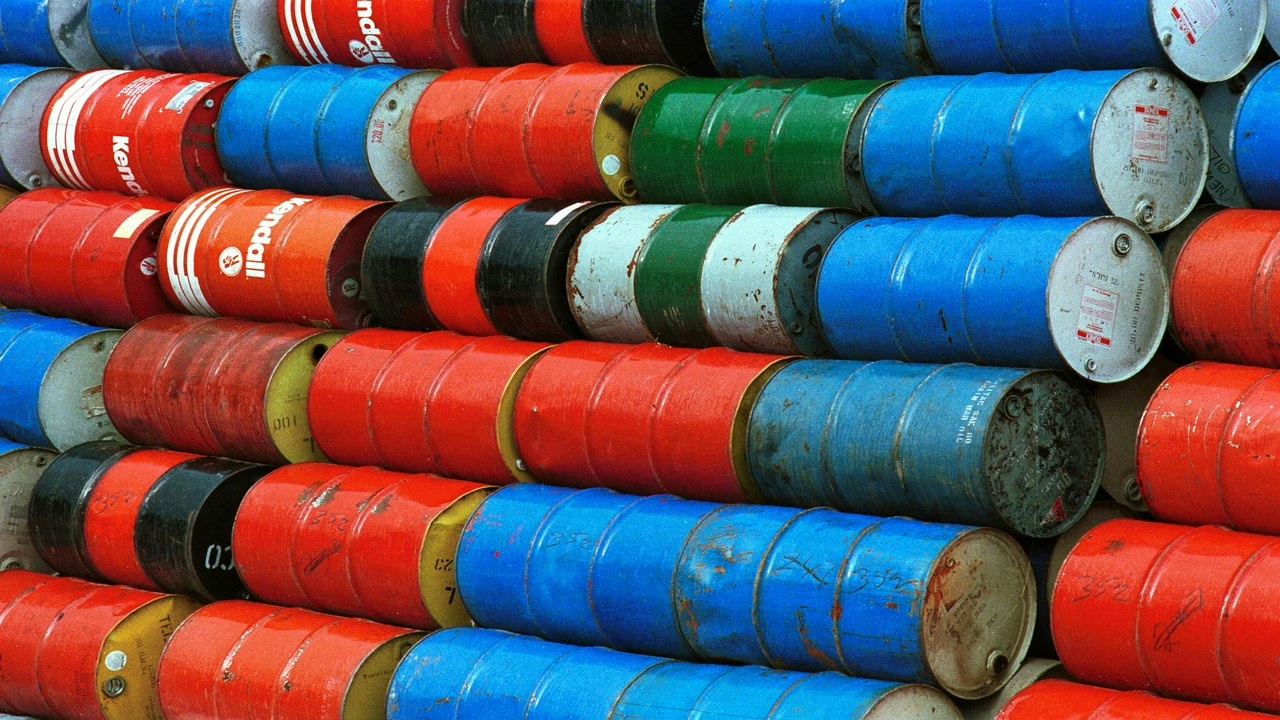
The sudden attack on Iranian oil depots, alongside Iran’s selective restrictions on oil shipments and production cuts from other oil producers, has triggered a surge in oil prices. For the first time since July 2022, oil prices surpassed $100 per barrel. It nearly reached $115 per barrel as of today.
Darkfost, a CryptoQuant analyst, explained in a tweet that the Strait of Hormuz accounts for approximately 20% of global oil exports. It also accounts for nearly 35% of oil shipped by sea. For this reason, any disruption to oil shipments through the Strait of Hormuz will trigger a surge in oil prices.
The analyst stated that oil has gained over 60% year-to-date amid lingering geopolitical tensions.
Effect on Financial Markets
As oil prices soared, stock prices and market indexes fell. According to Google Finance, Japan’s Nikkei slumped by over 5%, while India’s Nifty 50 dropped by 1.8% within the past 24 hours.
Under the European market, Germany’s DAX index dropped 1.51%, France’s CAC 40 declined by 1.73%, and the Stoxx 50 decreased by 1.75% at the time of writing.
U.S.-based market indexes saw minimal impact. For instance, Dow Jones, S&P 500, and Nasdaq are currently down 0.95%, 1.33%, and 1.59%, respectively.
The U.S. is largely unaffected by the constraints on the Strait of Hormuz because it gets most of its oil from Canada and Mexico. Although the country gets about 4% of its oil from Saudi Arabia, it is largely independent of oil transported through the Strait of Hormuz.
Impact on Bitcoin
It is no news that bitcoin’s price is often influenced by macro conditions, such as geopolitical tensions. Hence, the CryptoQuant analyst wrote:
“Historically, periods when oil prices regain strength often coincide with BTC end-of-cycle phases.”
In July 2022, the Russia-Ukraine war triggered an increase in oil prices to around $120 per barrel. At the time, BTC’s price slumped below the $20,000 threshold. This coincided with the infamous Terra LUNA crash and the Celsius bankruptcy filing.
However, the latest oil price pump has had no impact on BTC’s price, which has gradually increased over the past 24 hours. After dropping to as low as $65,600, the leading crypto has soared to $68,000. At the time of writing, it sold for $67,900.
BTC’s price movement stems from its close ties with the American market conditions. Top public companies building Bitcoin treasuries are based in the U.S. Additionally, most thriving spot Bitcoin exchange-traded funds, which hold billions of dollars in BTC, are also based in the country.








 Ephraim Emmanuel | October 14, 2026



 Jonathan Agozie | October 12, 2026