

Bitcoin whales are individuals or institutions that hold large amounts of Bitcoin (BTC) in their portfolio; therefore, they have the potential to influence the market. They are considered major players in the crypto space because their buy or sell actions in large volumes are capable of influencing the price of Bitcoin.
Therefore, it is necessary for investors or anyone seeking to venture into the crypto world to closely monitor the activities of these whales who make money for themselves while impacting the price of Bitcoin. This article demystifies the concept of Bitcoin whales and addresses some frequently asked questions about these entities.
Bitcoin Whales Explained
Bitcoin whales are individuals or organizations holding a substantial share of BTC. With large amounts of Bitcoin in their wallet, they have the potential to significantly impact price movements with their trading tactics.
Just as mammalian whales are the largest creatures in the ocean known for creating waves that affect other fish, similarly, Bitcoin whales are very influential in the crypto scene due to the size of their holdings when compared to other traders in the market. The trading activities of BTC whales in large volumes can cause waves that greatly affect traders in the crypto market.
Consequently, crypto traders and investors closely monitor whales ’ accounts since the movement of massive BTC holdings in their wallets gives them the upper hand to sway Bitcoin’s supply and demand with their trades, triggering price fluctuations.
When whales add to their Bitcoin stash, prices tend to soar due to the size of their trades because it gives the public the impression of high demand for the asset. Conversely, if a Bitcoin whale opts to exit their position by selling a portion of their holdings, the price tends to respond with a decline.
However, it is not in all cases that the movement of whales’ funds signals a sell-off. Sometimes, they could be changing wallets or exchanges.
While whales’ activities are often open to the public, with their wallets tracked by the trading community, there are occasions when they opt for over-the-counter (OTC) crypto trading to minimize their impact on prices.
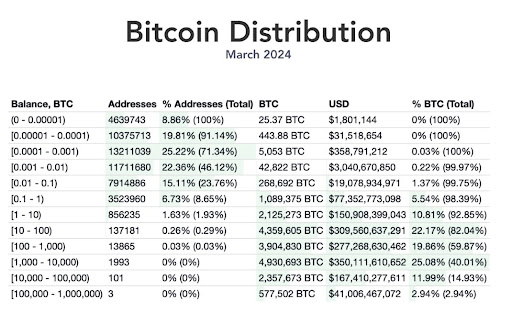
Whales are known to hold a significant share of the total circulating supply. As of March 2024, the distribution of Bitcoin ownership is highly concentrated. Only three Bitcoin addresses hold between 100,000 and 1 million BTC, totaling 577,502 BTC. The next 108 largest owners possess a combined total of 2,437,765 BTC, with individual holdings ranging from 10,000 to 100,000 BTC. These 111 wealthiest addresses collectively account for approximately 15.34% of the total Bitcoin supply.
Strategies Used by Bitcoin Whales
Bitcoin whales use various strategies to reap benefits and wield significant influence over its market dynamics. Here are a few of those strategies:
Accumulation
Whales can gradually build large Bitcoin positions over time by making calculated purchases during market downturns. They take advantage of market cycles, buying during periods of low prices and selling or holding through periods of strength.
Market manipulation
Bitcoin whales occasionally engage in a pump-and-dump strategy, which involves artificially inflating the price of BTC by buying large quantities of the coin at one time to drive up its price and then selling it at a higher price to make a profit, leaving other investors with a loss.
Arbitrage
In this scenario, Bitcoin whales take advantage of price differences between different exchanges. By buying Bitcoin at a lower price on one exchange and selling it at a higher price on another, whales can profit from the price discrepancy.
Portfolio Diversification
Apart from Bitcoin, some whales invest in other digital assets to diversify their cryptocurrency holdings. This strategy allows them to mitigate risk and to potentially profit from various areas of the cryptocurrency market while minimizing potential losses.
Long-term holding
Whales may also engage in ‘hodling,’ which refers to holding onto their Bitcoin for the long term, believing in its future value appreciation. By holding the asset for an extended period, the whales can protect themselves from inflation or possibly benefit from potential long-term price increases and avoid short-term market volatility.
Short and long hunting
When Bitcoin whales predict a price drop, they can use short-term strategies to sell large amounts of the cryptocurrency, scaring away smaller investors and driving the market lower. Conversely, they can use long-term strategies by strategically acquiring Bitcoin over time, which will generate positive momentum and encourage smaller investors to join the market, thus driving up the price.
Social media
Whales may start rumors on social media to give the public the impression of a high demand for the asset, which will potentially push up the price to attract smaller investors to join in. Bitcoin whales eventually sell, which causes a price decline and losses for small investors. By analyzing social media trends and news sentiment, whales can identify potential market movements and adjust their trading strategies accordingly.
How to Spot and Monitor Bitcoin Whales
Bearing in mind how influential whales are, it has become common for crypto traders and investors to monitor their activities to make informed investment decisions.
Identifying and monitoring BTC whales is possible because the blockchain is a public ledger that documents the activities and crypto balances of users. However, it is vital to note that it is only possible to determine the real-world identities of the owners of wallet addresses when they publicly reveal this information. Here are some ways to stop and monitor whales:
Blockchain Explorers
Bitcoin’s public ledger allows observers to see how much a whale address holds, how often it moves, and the destination of the funds. As a result, traders and investors anticipate their moves based on their previous decisions, which will aid the community in making investment decisions.
Some of the blockchain explorers include Whale Alert and blockchain.com.
Analyzing Trade Activities and Patterns
Analyzing whale trading patterns is essential in monitoring them, especially the large trades that might lead to sudden price spikes or dips. Furthermore, some whales engage in unusual patterns such as spoofing, which occurs when traders place large orders with the intent to cancel them before they are executed. This tactic creates artificial market movements, misleading other traders and potentially manipulating prices.
Social Media Presence
Some of the bitcoin whales are very active on social media, announcing all their major activities in space through their handles. They share their opinions, investment strategies, and the bitcoin market. Small traders and observers can infer some insights from their potential trading activities and use this information.
Search for large transactions
Large trades made by whales frequently cause abrupt drops or increases in price. When a large amount of cryptocurrency moves, it is usually because whales are transferring it between wallets or exchanges. Bitcoin’s public ledger can help access all whale transactions and identify large amounts of Bitcoin being moved.
Watch for unexpected market movements
If unexpected market movements occur without clear news or events to explain them, it could signal the presence of a whale swimming somewhere close. Whales typically cause market fluctuations by purchasing or selling large amounts of cryptocurrency.
How to Become a Bitcoin Whale
There is no official threshold for whale status, but the widely used benchmark is a minimum of 1,000 BTC. Analytics platforms often use a further tier system, from “shrimp” (less than 1 BTC) up through “whale” (roughly 1,000 to 10,000 BTC) and “humpback whale” (10,000 BTC or more). At current prices, owning even one of the wallets in the humpback tier would make someone a billionaire many times over.
According to data from a website called Bitinfocharts, among the 100 richest wallets in its list, there are over 100 wallets with 10,000 coins or more. Owning one of these wallets would make one a billionaire.
Recent Developments in 2026
The composition of Bitcoin’s largest holders has changed substantially since spot Bitcoin ETFs launched in the United States in January 2024. A few key shifts worth noting:
Spot ETFs now rival or exceed individual whales. Collectively, spot Bitcoin ETFs hold well over 1.29 million BTC as of mid 2026, according to Arkham data, a figure that in aggregate now surpasses Satoshi Nakamoto’s long-dormant stash. BlackRock’s iShares Bitcoin Trust (IBIT) is the single largest institutional holder among them, with holdings reported near 785,000 BTC as of early 2026, followed by Fidelity’s Wise Origin Bitcoin Fund (FBTC) with roughly 180,000 to 187,000 BTC.
Corporate treasuries remain enormous but volatile. Strategy (formerly MicroStrategy), led by Michael Saylor, remains the largest publicly traded corporate holder, with reported holdings ranging from roughly 750,000 to over 840,000 BTC across different points in 2026 as the company has continued adding to its position. Other public companies with meaningful BTC treasuries include Marathon Digital (MARA), Metaplanet in Japan, and SpaceX, which entered the list following its own public listing.
Governments are formal holders now, not just accidental ones. Following a March 2025 executive order establishing a Strategic Bitcoin Reserve, the United States now formally holds Bitcoin obtained through law enforcement seizures rather than auctioning it off, with estimates placing US government holdings between roughly 198,000 and 328,000 BTC. China is estimated to hold around 194,000 BTC seized from the PlusToken Ponzi scheme, despite its domestic ban on crypto trading. Smaller sovereign holders include El Salvador, which continues to hold and periodically add to its reserve, and Bhutan, which built its position through state backed mining but has been selling down its stash in 2026 to help fund a domestic economic development project.
Stablecoin issuers have become notable whales in their own right. Tether, issuer of USDT, has committed to investing a share of its profits into Bitcoin since 2023 and now holds close to 96,000 to 97,000 BTC as part of its reserves.
Price volatility has kept whale activity in the spotlight. Bitcoin traded near record highs above 120,000 dollars in late 2025 before pulling back into the 58,000 to 80,000 dollar range through the first half of 2026, a swing that has kept both spot whale accumulation and derivatives whale positioning under close watch by analysts.
Frequently Asked Questions
How do Bitcoin Whales Make Money?
Crypto whales stand out from ordinary investors because they take a long-term view of the cryptocurrency market and often use advanced investment tactics.
Most of their holdings come through mining, early investment, hodling, and other methods. Their access to substantial Bitcoin holdings provides them with the capabilities to control and manipulate the market through major asset purchases or sales that can lead to price fluctuations.
Do Whales Always Make a Profit?
While it’s true that whales can have a significant impact on market movements, it does not mean that the market is always favorable to them or that profit opportunities are exclusively reserved for them.
Whales may have an advantage due to their significant holdings; however, it is important to remember that the cryptocurrency markets are highly dynamic and constantly evolving. There are opportunities for traders of all sizes to profit from market movements, provided they approach trading with a disciplined mindset, sound strategies, and the right tools.
Who are some of the largest Bitcoin holders today?
At the top of the list is still the pseudonymous creator of Bitcoin, Satoshi Nakamoto, believed to hold approximately 1.096 million BTC across thousands of addresses that have shown no spending activity in over a decade. Beyond Satoshi, the field is now dominated by institutions: spot ETFs like BlackRock’s IBIT and Fidelity’s FBTC, corporate treasury holders like Strategy, Marathon, and Metaplanet, stablecoin issuer Tether, and governments including the United States and China. Notable individuals such as Michael Saylor, the Winklevoss twins, and Tim Draper remain part of the conversation, though their personal holdings are now dwarfed by institutional totals.
Are spot Bitcoin ETFs considered whales?
In aggregate, yes. Spot Bitcoin ETFs do not represent a single owner, since the underlying Bitcoin belongs to the fund’s shareholders rather than the ETF provider itself. But because these funds custody and move large blocks of BTC on behalf of thousands of investors, their combined holdings behave like a whale for market purposes. As of 2026, ETFs collectively hold more Bitcoin than any single known entity, including Satoshi Nakamoto.
How does the US Strategic Bitcoin Reserve affect whale dynamics?
Since the reserve was formalized in March 2025, the United States has stopped routinely auctioning off Bitcoin seized through law enforcement action and instead holds it as a national reserve asset. This effectively removes a recurring source of sell pressure that the market had priced in for years, and it has turned the US government into one of the largest and most closely watched sovereign whales.
Do whales always make a profit?
Not necessarily. Large holdings give whales an advantage, but crypto markets remain highly dynamic, and even major holders have absorbed significant paper losses during sharp pullbacks in 2026. Traders of all sizes can profit from market movements with a disciplined approach, sound strategy, and the right tools, and whale status is no guarantee against loss.
What tools can I use to track whale activity in 2026?
Beyond long standing tools like Whale Alert and Blockchain.com, platforms such as Arkham Intelligence and Glassnode have become widely used for entity clustering and on-chain flow analysis, allowing traders to see not just individual wallet balances but the aggregated holdings of companies, funds, and governments. For derivatives focused whale tracking, platforms that surface positioning data from on-chain perpetual exchanges like Hyperliquid have also become a regular reference point for anticipating short term price moves.
Conclusion
Bitcoin (BTC) whales often command attention from other market participants due to their significant holdings and the impact of the movement of their funds on the price. While monitoring their activities can help make wise decisions in the market, it is important to remember that they can make emotional decisions without rationality, or some movements might be aimed at manipulating the market.
Therefore, it will be vital for investors to exercise caution when monitoring whales’ activities to avoid falling prey to some schemes. It is also necessary to conduct thorough research when making investment decisions.






 Jonathan Agozie | August 14, 2026
 Mishael Nwani | August 14, 2026

 Fortune Samuel | July 2, 2026
 Cynthia Ezirim | July 1, 2026
