Bitcoin is currently trading at $72k. Its recent price followed a failed attempt to break above $78k on Tuesday, resulting in several days of consistent downtrend.
In hindsight, May has been as bullish as many anticipated. After the notable increases seen during the first fourteen days, BTC has been declining, shedding all of its accumulated gains. Based on a month-to-date basis, the asset is seeing notable losses.
With the apex coin nearing a level not seen in almost two months, it is a grim reminder that the bear market is still on. The steady uptrend between April and early May gave the illusion that it was over as the asset returned to three-month highs.
However, the last fourteen days have gradually disillusioned investors. Nonetheless, the crypto market is relatively quiet. It has been so since the failure to reclaim $83k. At the top, some proponents argued a surge to $90k is likely. Following the rejection, a small number of analysts have been vocal about their expectations.
Additionally, some traders are exiting the market and pivoting into stocks as they claim the market is “dead.” In all of this, it is clear that the spark and excitement that once filled the crypto street are almost nowhere to be found. While it is a sad development, it is not surprising considering the current bear run.
As the street becomes quieter and the “crypto is dead” calls rise, something else comes across this period. Some analysts contend that the 2025/26 bear market is built differently. Why is that so?
Institutional Participation
Bitcoin has been a critical asset for investors seeking a high-yield asset, and it was that way for years. Over the last four bear markets, these investors, mainly retailers, had some of the biggest shares in the market and made some major moves.
For example, the first-ever bear market was the 2011 flash drop. The trigger was when Mt. Gox fell victim to hackers who carted off more than 25,000 BTC at the time. The apex coin dropped 94% following the announcement.
However, it is interesting that the total lost assets belonged to just 478 users. Although worth over $400,000 at the time, such a huge amount of cryptocurrency belonging to just these users shows that retailers maintained control of the market.
The 2013/15 bear market also had the same trigger: Mt.Gox. This time, they announced they lost 850,000 BTC to hackers and shut down. The result: a devastating 85% decline. Although the number of those affected by the hack was not disclosed, the shutdown affected around 127k users at the time. The figures show that retailers were the biggest losers.
Interestingly, the 2018 winter was led by selling from the group that maintained control over the last two bear markets. However, that began to change in 2020 when Microstrategy began accumulating BTC.
During the 2021/22 bear market, the company continued to accumulate, and 30 to 40 others joined the frenzy. It marked the beginning of a shift from the retail-driven market to an institutional-driven one.
The number of institutions investing in Bitcoin has since grown, topping 100 at the time of writing. This is the key difference from the other bear markets. Unlike other bear markets where retailers were at the helm of affairs, companies holding the apex coin now have greater control.
To put this into perspective, institutions now own over 18% of the total supply, with some boasting up to 800k BTC.
ETF: Key Difference
Still on institutions owning BTC, some firms decided that instead of holding the asset directly, they would rather have ETF exposure. As a result of these organizations and individuals, ETF companies now hold around 1.30 million BTC.
In hindsight, Bitcoin exchange-traded funds were first launched in 2024. It has since grown exponentially in value, as SoSoValue puts the net value at $94 billion.
Interestingly, this is another key difference from the previous bear market. ETFs are now a major player, and they’ve also played a major role in price movements so far.
Weaker Altcoin Market
Away from institutions, the altcoin market is struggling. During the bull run, memecoins took center stage among this asset class, but when the hype surrounding them died, it appears it took the entire market with it.
In previous bear runs, altcoins have outperformed Bitcoin. Investors always waited for altseason to diversify from the apex coin to other assets. At the time of writing, there has been no such season or period during this run.
The Bitcoin dominance chart better explains what is happening. During previous bearish periods, the dominance fell below 40%. However, during this run, it maintained a dominance of 57% at its lowest.
The interest in altcoins has notably declined, resulting in a weaker altcoin market. Nonetheless, some may contend that assets like HYPE, H, ZEC, and TAO are experiencing a massive surge at the time of writing.
While this is true, it has had no strong impact on the larger market. During previous altseason, alternative cryptocurrencies in the top 10 led the uptrend. However, most of the assets are currently negative.
This is the second difference from the other bear markets; the normal altseason or altcoin uptrend seen in previous runs is not present.
Bitcoin Now Acts Like a Traditional Asset
In recent times, when geopolitical and other world events shook the traditional markets (Stocks, bonds, etc), investors flocked into the crypto market to hedge against these happenings. Interestingly, when those markets recover, Bitcoin re-correlates with them.
Bitcoin is now trending like these traditional assets. For example, when the US president announced several tariffs on the EU and other countries, the apex coin dipped, as did several stocks. When he relaxed the levies, it recovered.
The most recent event is the conflict in the Middle East. When it started, the world’s markets shed trillions, and so did Bitcoin. When both parties declared a ceasefire, BTC saw an extended recovery that resulted in a surge above $80k.
Lastly, US economic data also plays a huge role in price action. Traders now monitor the BLS report, and some base their decisions on what they find.
During the previous bear market, Bitcoin was decoupled from world events, and traders did not worry about the US data.
In conclusion, institutional involvement, disinterest in altcoins, and the recent change in Bitcoin behaviour have made the current bear market different from the previous. These factors have also contributed to another key event taking place during this run: reduced volatility.
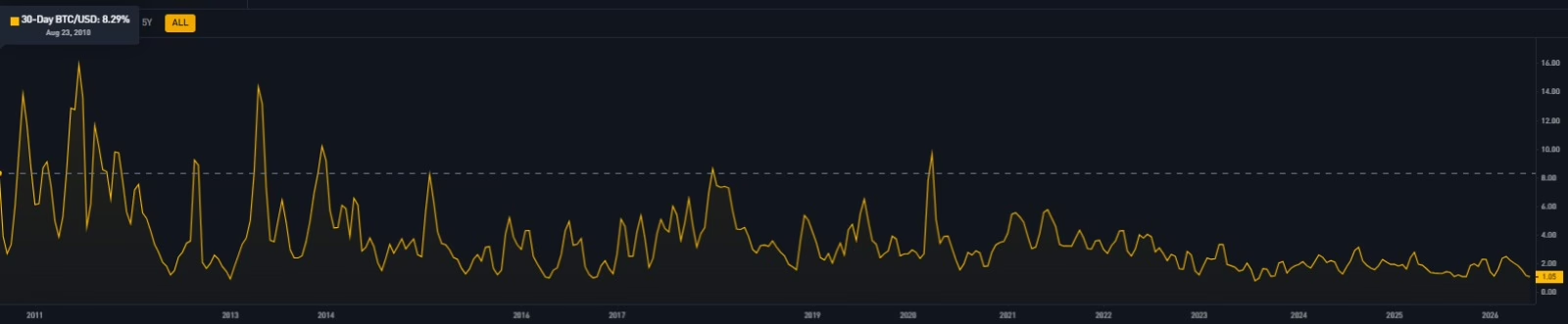
The chart above is the Bitcoin volatility index. Focusing on the 30-day average reveals that since 2012, BTC volatility has averaged 4.50%. However, the metric is close to its lowest since inception. Additionally, its movement has also significantly slowed.
It remains to be seen if volatility will improve. However, recent price actions suggest that the bear market is far from over.