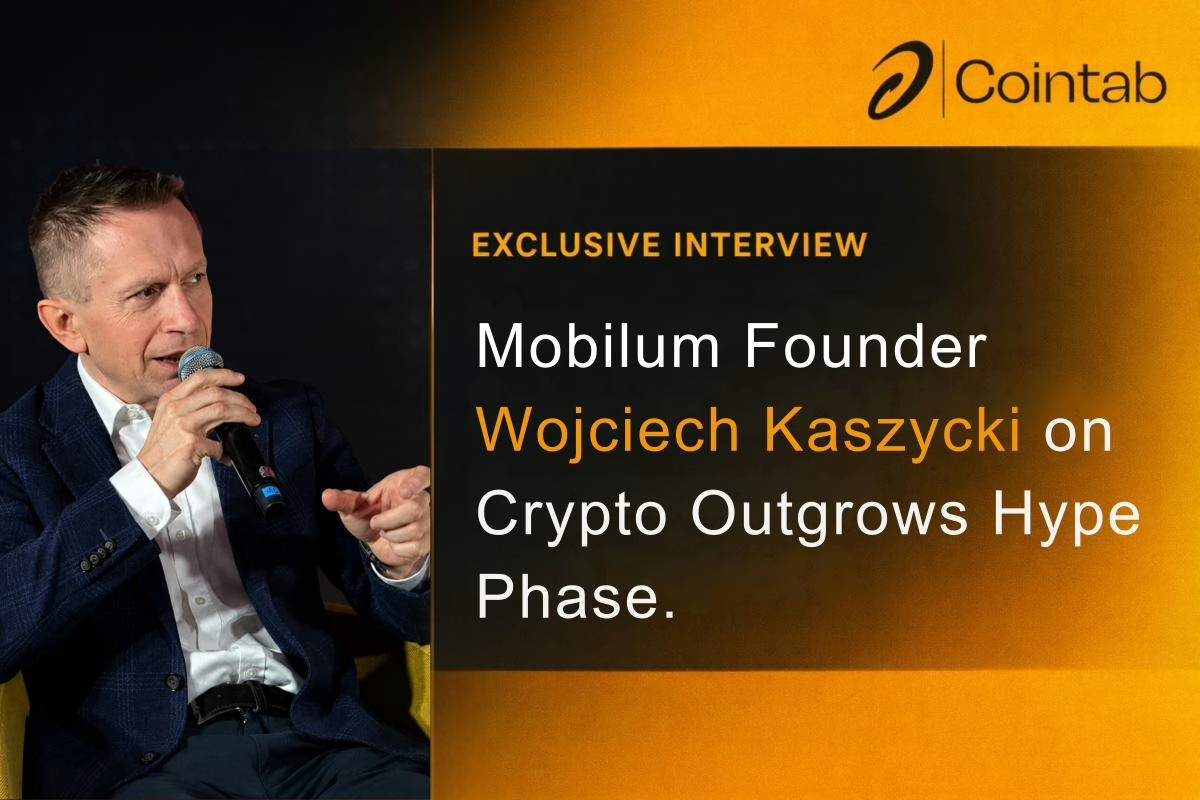
As the crypto industry advances beyond hype and speculation-driven cycles, the emphasis is driving towards real-world utility, regulation, and long-term sustainability. On that note, CoinTab recently spoke with Wojciech Kaszycki, founder of crypto payments platform Mobilum and the Chief Strategy Officer at BTCS S.A.
In this exclusive interview, Kaszycki shares experience-filled insights on Mobilum’s evolving crypto payments system and BTCS’s approach to Bitcoin treasury strategy. He also discussed how European regulations are affecting the crypto space and why he believes the future of crypto will be built on strong infrastructure rather than on narratives alone.
But before diving into the interview, let’s take a brief look at Wojciech Kaszycki’s background and decades-long experience across fintech, payments, and the crypto industry.
Three Decades of Experience Shaping a Crypto Vision
Before founding Mobilum, Kaszycki was in the fintech and payments service industry for over 30 years. He played a major role in the development of several premier e-commerce platforms in Poland.
Kaszycki managed AGS NewMedia between 1997 and 2001 and helped in the creation of cEmpik.com, sometimes called the Polish Amazon.
According to the serial entrepreneur, he drew on the decades of experience he had gathered in founding the Mobilum platform and in his CSO role at BTCS. While at this, Kaszycki mentioned that he is more focused on infrastructure designed for real-life operational demands, as the market matures and regulations like MiCA push the industry towards operational discipline.
“The biggest lesson is that infrastructure will always matter more than narrative. Markets will change, regulations will evolve, and cycles come and go. Only If you build real rails for payments, custody, treasuries, and settlements will you stay relevant,” Wojciech stated.
Building Trust Through Payment Systems and Regulation
As users continue to seek transparency, faster complaint resolution, and operational clarity, Kaszycki stressed that Mobilum also evolves to fit their needs.
“Trust is not built solely by access to crypto payments anymore; it is also built by processes.”
Based on the statement, the Mobilum co-founder said that the platform has updated its service systems to handle “fraud reporting, refunds, chargebacks,” and has even implemented a 14-day complaint resolution timeline.
Beyond compliance, he added that Mobilum would level up its on- and off-ramp systems to streamline the connection between banks and blockchain systems.
“Mobilum’s public roadmap already points in this direction with broader bank-rail support, open banking, ACH-SWIFT connectivity, token bridging, and other network functions being highlighted as part of this ongoing ramp evolution.”
Wojciech also spoke on Europe’s evolving regulations as they move towards a more serious compliance phase. He noted that while MiCA and similar frameworks legitimize the industry, differences in how countries interpret and apply the rules can pose barriers to innovation and cross-border operations.
BTCS Beyond Bitcoin Holdings
Speaking of crypto treasuries, Kaszycki discussed how BTCS positions itself within the growing Bitcoin treasury ecosystem and what distinguishes a real operating treasury from one that is merely accumulating assets.
He emphasized that while Bitcoin is the core asset BTCS accumulates, the management company is on a smaller scale than Strategy’s BTC in the public reserve. Rather than focusing on the amount of assets accumulated on the balance sheet, the CFO asserts that BTCS prioritizes developing an operating model that integrates treasury management with “infrastructure, transparency, and execution.”
Further, Kasycki addressed one of the pressing matters in the industry: the growing trend of publicly traded companies holding crypto without having a clearly defined operational plan. To help investors pick a good treasury company, he listed indicators such as operating revenue, trackable KPIs, treasury frameworks, and infrastructure capabilities to focus on.
When queried how BTCS might approach consolidation based on current trends, he revealed:
“A realistic consolidation playbook isn’t about buying random crypto exposure, it’s about acquiring or combining assets that improve one of three things: treasury scale, infrastructure capabilities, or regulatory positioning. For BTCS, that could mean looking at targets that will add validatory operations, tokenized asset access and distribution, or a strong public market wrapper.”
This only means that companies that can seamlessly integrate “capital, operating yield, and infrastructure” have a greater chance of becoming long-term consolidators in the crypto space.
The Future of Tokenized Finance and Crypto
Looking ahead, Kaszycki anticipates a future where the boundaries between crypto payments, treasury management, and tokenized finance will disappear faster than most expect. As these functions continue to merge, tokenized capital markets are gaining traction across Europe. Kaszycki pictures Mobilum and BTCS playing complementary roles, with the former positioned at the user-access and payments layer, and BTCS operating on the treasury and infrastructure side.
He described a future where these structures operate as one. As tokenized capital markets continue to gain traction across Europe, he sees companies like Mobilum and BTCS playing complementary roles, with Mobilum positioned at the “user-access and payments layer” while BTCS focuses on the “treasury and infrastructure layer.”
He concluded, “Over time, the most interesting businesses may be those that can connect compliant fiat access, digital asset treasuries, and tokenized financial products into a coherent stack. That is where I believe the market is heading.”






 Sampson Gideon | May 29, 2026

 Wilfred Michael | March 26, 2026