
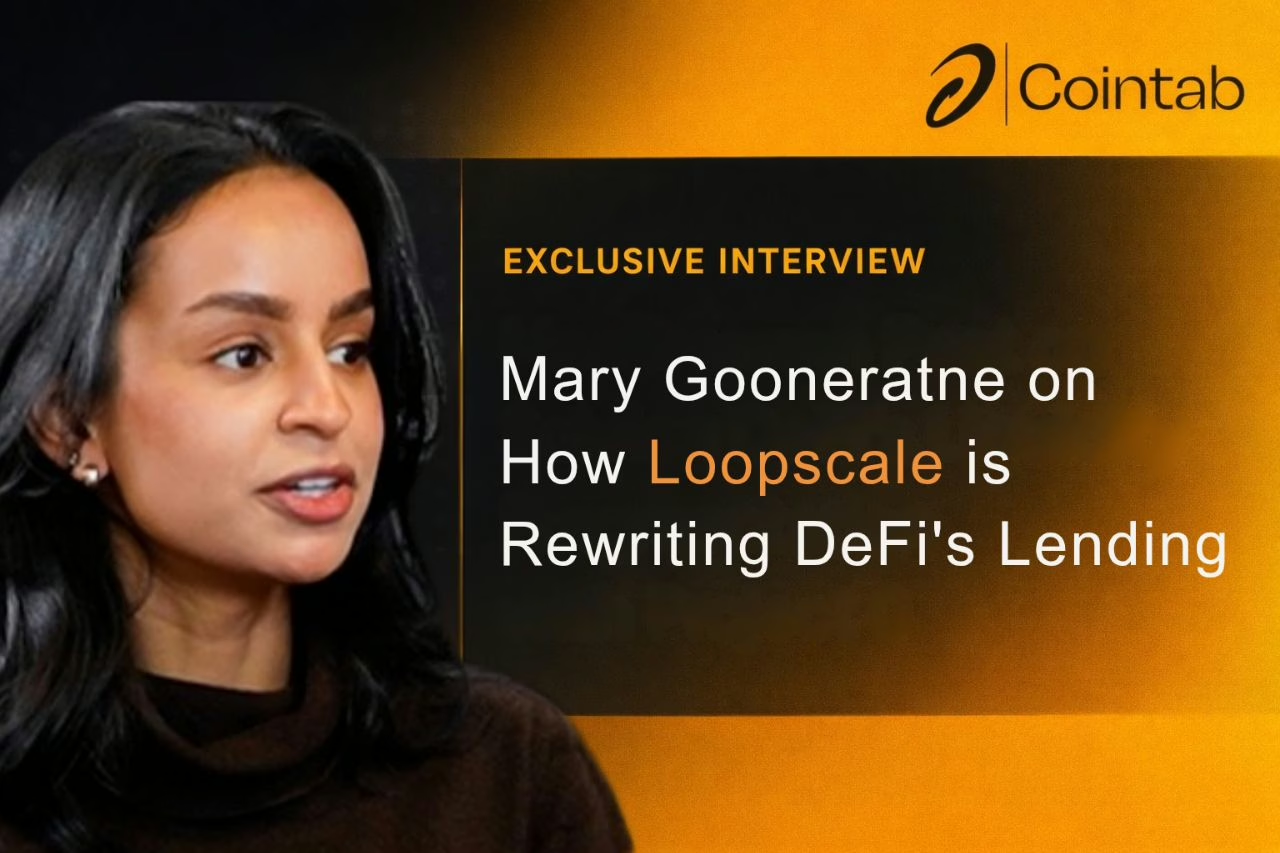
For years, DeFi lending has centered on liquidity pools, where users deposit assets, algorithms set rates, and borrowers draw from shared capital. However, Mary Gooneratne, Co-founder and Chief Operating Officer at Loopscale, believes that this approach was never meant to be the final solution. She stated, “If you were designing credit from scratch today, you wouldn’t design a pool.”
We recently had a chat with Mary, and she shared her thoughts on why DeFi lending needs to evolve beyond liquidity pools and towards real, order-book-based credit markets. The Loopscale co-founder also revealed how the platform is building fixed-rate, risk-priced lending on Solana, its rapid growth and institutional traction, the team’s response to a 2025 exploit, and why tokenized real-world assets could reshape the future of on-chain finance.
To set the stage, here’s some context on Mary Gooneratne and the Loopscale platform.
Background: The Founder and the Platform
Mary Gooneratne, based in New York, is the Co-founder and Chief Operating Officer at Loopscale. Before developing the platform, she’d been building on Solana since 2021, making her a longtime contributor to the ecosystem. She has also held roles on several projects, including as a co‑founder of Phoenix.
Loopscale, launched on April 10, 2025, is a decentralized lending protocol built on the Solana ecosystem that uses an order-book model. Mary’s vision to redesign on-chain credit markets from a pool-based lending model to an order-book model was a key driver in the creation of the Loopscale platform, in order to make on-chain lending competitive with traditional financial systems.
Bringing Her Vision to Life
In the interview, Mary stated that the traditional DeFi lending models use shared liquidity pools where the borrowing rates are set algorithmically and applied uniformly, instead of proper risk-based pricing, fixed rates, or customized loan terms.
Due to this type of structure, different assets are treated the same, whether it’s a USDC, SOL, or USDT. Mary believes that for DeFi to truly compete with traditional finance, it needs some changes. DeFi needs to evolve to an order-book model where rates are determined by actual market supply and demand.
However, there was a problem. Running a system like this can be expensive and slow, and only a high-speed, low-cost network like Solana can support the real-time matching required for on-chain order-book lending. Hence, Loopscale was built on that very blockchain.
According to Mary, “On Loopscale, every loan is bilateral and fixed-rate, matched on an order book with custom terms, any collateral set, and any duration. Lenders can price risk per collateral type, set their own LTVs, and choose exactly what exposure they want.”
“That combination – order book price discovery, bilateral fixed-rate loans, per-collateral risk pricing, all running on Solana – is what makes Loopscale a fundamentally different kind of lending protocol. This is what on-chain credit actually looks like when you build it the way credit markets have always worked.”
Loopscale Expansion
Going forward, Loopscale hasn’t changed its foundational belief in the order-book system. Instead, the method has increasingly been backed by broader industry trends. For instance, Mary mentioned that Morpho, another DeFi lending protocol, adopted the order book system for its V2.
Meanwhile, for Loopscale, its core architecture hasn’t changed; rather, it has expanded significantly. After undergoing a six-month closed beta phase before its launch, the platform has subsequently increased its support from crypto-native collateral to tokenized real-world assets like “Securitize’s ACRED (Apollo Diversified Credit Fund), tokenized reinsurance through ONyc, tokenized equities through xStocks and Remora Markets, Brazilian and Mexican treasury bonds through Etherfuse, and much more,” to serve both DeFi users and institutional-grade financial products.
However, Mary mentioned that adding tokenized real-world assets, especially tokenized stocks, poses some challenges because they differ from crypto-native tokens. For instance, tokenized stocks are only available during U.S. market hours, which ultimately affects liquidations, pricing feeds, and the leverage mechanics of lending protocols built on a liquidity pool system.
To tackle this issue, Loopscale set up a bilateral structure to give each asset customized risk parameters, fitting loan-to-value ratios, controlled liquidation processes, and pricing through Pyth oracles.
Another problem these tokenized stocks pose is regulatory limitations that require permissioned access at the collateral level. Loopscale also designed built-in asset segregation and structured controls to handle this.
When asked if tokenized equities would become a core pillar of DeFi lending or remain a niche, Loopscale co-founder responded, “Core pillar, but still early. We already support tokenized stocks from xStocks and Remora Markets, plus Flash.Trade’s FLP.r pool token (which is Remora Stocks + Flash.Trade fees yield), and the demand is real. The reason I’m bullish: it gives global users access to U.S. equities with full DeFi composability and capital efficiency.”
Scaling Through Product Innovation and Market Demand
Based on statistics, Loopscale has recorded significant growth since its launch, driven by both product innovation and ecosystem alignment. Loopscale started 2025 with $10 million in deposits and entered 2026 at $150 million, marking a significant expansion.
Mary listed about three key factors that have contributed to the growth of the platform. First was the launch of Loops, a “one-click leverage product” that simplified the borrowing system to a single-step transaction, thus broadening access to the platform’s order-book infrastructure.
Secondly, building partnerships with platforms like OnRe and Hylo, which brought new user bases, further strengthened Loopscale’s credibility and pushed its records from $45M to $100M in deposits and attracted over 3,500 users every week.
Another factor that contributed to the growth of Loopscale was the adoption of real-world asset (RWA) issuers like ACRED and ONyc, due to its order-book system.
Alongside its broader expansion, Loopscale has also seen significant growth in its users’ behaviour, which has exceeded expectations. Notably, user activity remained resilient even during market volatility, with consistent lender and borrower engagement, and demand often exceeding vault capacity.
Loopscale 2025 Exploit
While recording significant growth, the platform also had its bad times. Narrating the incident, Mary explained that Loopscale suffered a security breach in 2025, during which an attacker exploited a vulnerability in the platform’s collateral pricing and withdrew about 12% of protocol funds.
Following the attack, the Loopscale team began damage control. The company paused withdrawals, started investigations into the security breach, and updated users about the attack. Two weeks after the attack, the platform successfully retrieved the stolen funds with no users losing their deposits.
To avoid a similar breach, Loopscale tightened its security standards by publishing a post-mortem and undergoing multiple external audits by Sec3, Adevar Labs, and Highland Security.
Mary also added, “Every program change now goes through an independent audit before launch. We expanded our internal security processes, added safeguards around Oracle pricing and collateral valuation, and vaults now have time-based withdrawal caps. All funds were recovered and returned to users, and the growth since then to $100M+ in deposits speaks for itself.”
Looking Ahead
When asked what role she would be playing if Loopscale performs exceptionally well in about three years to come, Mary mentioned that she sees herself continuing to build rather than stepping away, given her current position as a founder.
The Loopscale co-founder also added that she envisions the protocol to become the foundational credit layer for on-chain finance.
Talking about future launches or updates, Mary revealed, “We’re in the polishing phase for some major upcoming features, and there are significant announcements on the horizon. New asset classes, deeper institutional integrations, and more primitives that make Loopscale the most powerful lending infrastructure on Solana.”
As for long-term price predictions on SOL or BTC, the Loopscale co-founder did not mention any particular figure. Instead, in an optimistic tone, she pointed out that, with the way the Solana ecosystem is evolving (from recording $300M in total TVL two years back to spot Solana ETFs trading on the NYSE, along with other developments), the signals point to growing institutional adoption. She concluded, “You are not bullish enough.”






 Sampson Gideon | May 29, 2026
 Wilfred Michael | March 26, 2026
