
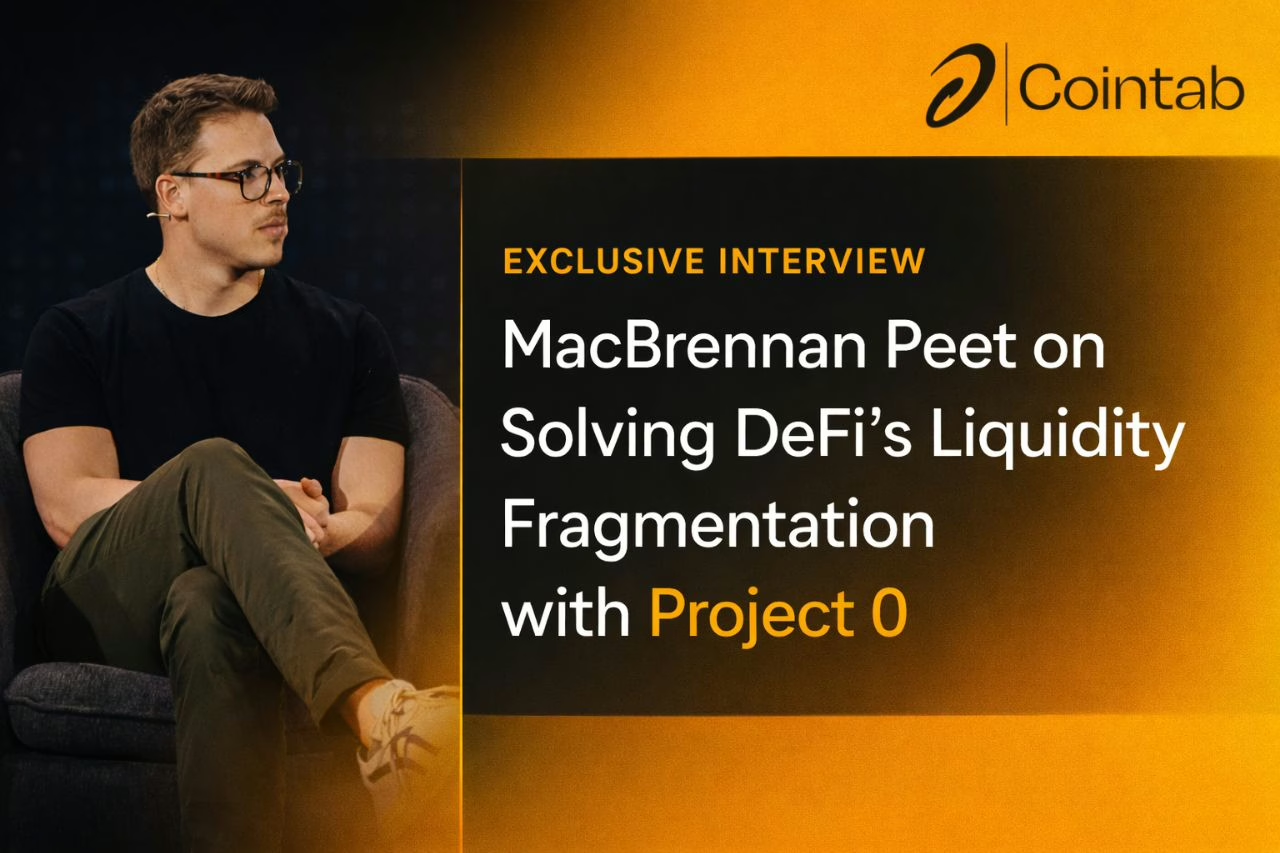
“DeFi was supposed to make everything composable, but it somehow made everything more fragmented.” With these words, MacBrennan Peet introduces us to one of the persistent challenges that continues to plague decentralized finance, especially for users managing two or more accounts across different platforms.
In this exclusive interview, Peet, Founder and CEO of Project 0, shares his insights into how his Solana-based platform aims to address fragmented liquidity in DeFi through unified margin and cross-venue risk management.
Additionally, we’ll hear details on how Project 0 handles risk across multiple venues, and one of its toughest hurdles in building the platform. Finally, the article will explore where Project 0’s founder aims to be in three to five years and his prediction for SOL’s price in a few years.
First, let’s get to know MacBrennan Peet and the Project 0 platform.
From TradFi to DeFi
Before launching Project 0, MacBrennan Peet built a career spanning traditional finance, hedge funds, health tech, Web3, and the DeFi sector. He has also built and exited various platforms, including Marginfi, MRGN Research, and Temporal, and is currently the founder & CEO of Project 0.
Project 0 is a “DeFi-native prime broker” built on the Solana ecosystem. You can learn more about its features and yield strategies in our in-depth article. However, the platform’s goal is to consolidate borrowing, lending, and leveraged trading across various decentralized protocols into a single, capital‑efficient platform. This feature gives an edge to market makers, funds, and advanced crypto investors who are managing liquidity across different venues.
Fixing DeFi’s Liquidity Fragmentation
According to Peet, his transition into Web3 was driven by a mission to solve one of the common problems in DeFi – liquidity fragmentation and isolated margin systems. The problem occurs when a user intends to utilize various financial venues like “perps, swaps, lending, or rates”, which ends up scattering the user’s funds across platforms, reducing capital efficiency.
To address this issue, Peet shared that the Project 0 platform was intentionally designed to tackle fragmentation. As he puts it, one of the platform’s primary goals is to “re-unify this experience so that the diverse nature of DeFi can flourish across the many different venues users love today, without leaving behind capital efficiency on behalf of the user. Instead, we give them unified risk, rates, margin, credit, and UX.”
The Project 0 founder also added that the platform allows DeFi users who juggle two or more venues to borrow against their entire portfolio, not just parts. The platform also improves account health by recognizing offsetting positions across venues, something individual venues can’t do.
Managing Risk While Pioneering a New DeFi Model
Beyond solving liquidity fragmentation in DeFi, Mac shared more details about his Solana-based platform. When asked how Project 0 manages risk across venues, Peet mentioned that the platform uses an “automated risk engine” built in-house called Brutus, which assigns each asset from a list of qualified collateral assets to its risk limits.
“Brutus monitors a variety of inputs spanning market liquidity for assets, volatility, underlying asset mechanisms (like minting/redeeming), and more. On the program security side, we work with multiple auditing firms and are built on code that has been live in production for 3+ years without incident… weathering all market conditions on Solana during that period.”
Peet also added that he encountered hurdles when building the platform because it was entirely new in DeFi. One of the toughest challenges was teaching DeFi users how the platform works, a necessity, especially for those juggling 2 or more accounts.
Long-Term Outlook
Speaking on his vision for where Project 0 will be in the next 3-5 years and the lasting impact he believes it will have on the broader DeFi ecosystem, Peet stated, “I want Project 0 to have integrations spanning all the most used DeFi programs in crypto as soon as possible. If there are venues people are using that’s not on Project 0 in 3 years, we’ve failed. Each new integration is hard, but I believe we can move faster and faster on integrations with the new infrastructure we’ve built.”
Turning to the broader ecosystem, Peet also offered his long-term vision for Solana’s future. He stated that in about 5 years, Solana should have expanded beyond trading crypto tokens to real-world financial assets such as stocks, commodities, and other investment products.
So rather than randomly guessing SOL’s future price, Peet shared that advancements in the ecosystem would determine SOL’s value in the years to come.
Get Trending Crypto News as It Happens. Follow CoinTab News on X (Twitter) Now





 Sampson Gideon | March 5, 2026
 Wilfred Michael | July 2, 2024
 Elendu Benedict | May 24, 2024
