
Ethereum has remained rangebound over the last seven days. It attempted to break out on Wednesday but failed as buying pressure has yet to improve significantly.
Nonetheless, the asset has failed to register a notable move since the first half of the previous week. Adding to the concerning developments is the growing number of dojis on the 1-day chart, while trading volume remains relatively low.
A few hours ago, Ethereum recorded a notable uptick following the release of positive U.S. inflation data. The BLS released the latest Personal Consumption Expenditures report, and the figures came in largely as expected, with some metrics performing better than anticipated. For example, year-on-year core PCE came in at 3%, below the expected 3.3%. The month-on-month reading for the same metric was unchanged from the previous month.
Investors initially reacted positively to the data, as the moderation in some inflation measures suggested that price pressures could be easing. However, the optimism was not enough to trigger a breakout, and ETH soon gave back part of its gains.
The final days of the month are becoming increasingly uneventful for the asset. However, this masks the milestones Ethereum achieved earlier in September.
Ethereum Sets New 8-Month High
During the second half of August, Ethereum faced notable selling pressure around $2,520 and traded below the level for most of the period. It broke above the resistance on September 11 and 14 but quickly retraced on both occasions.
The anticipated U.S. rate hike contributed to another period of weakness over the following days. Interestingly, the rate decision was followed by the catalyst for Ethereum’s eventual breakout. ETH broke above $2,600 on September 18 and flipped $2,800 the following Monday. The altcoin subsequently reached a new eight-month high that same day.
Improving fundamentals also coincided with renewed liquidity entering the asset. One area that recorded significant inflows was exchange-traded funds. U.S. spot Ethereum ETFs registered their biggest net inflow of the month on September 21, at roughly $270 million.
Zooming out, Ethereum ETFs recorded approximately $892 million in net inflows over the last 29 days, making September their second-largest monthly inflow period since August 2025.
In terms of price, Ether is approaching a monthly close with gains exceeding 9%. It is also on course to record its third consecutive month of gains.
While the 9% increase is notable, it also masks signs of buyer exhaustion.
In August, ETH closed more than 32% above its opening price, while July ended with gains exceeding 18%. September has been different. The asset has remained mostly rangebound after its initial advance, suggesting that upward momentum is fading.
If market conditions improve, ETH could attempt a move toward $3,300 within the next 30 days. Conversely, if the current conditions persist, October could begin with another correction.
Why $3,300 May Be the Target
The 1-week chart shows several important trading zones. At the time of writing, ETH is at a crossroads. Last week, it attempted to break into a higher zone but failed, increasing the near-term downside risk.
Going into the new month, two zones are particularly important: the $2,800-$3,300 range and the $2,100-$2,780 range. 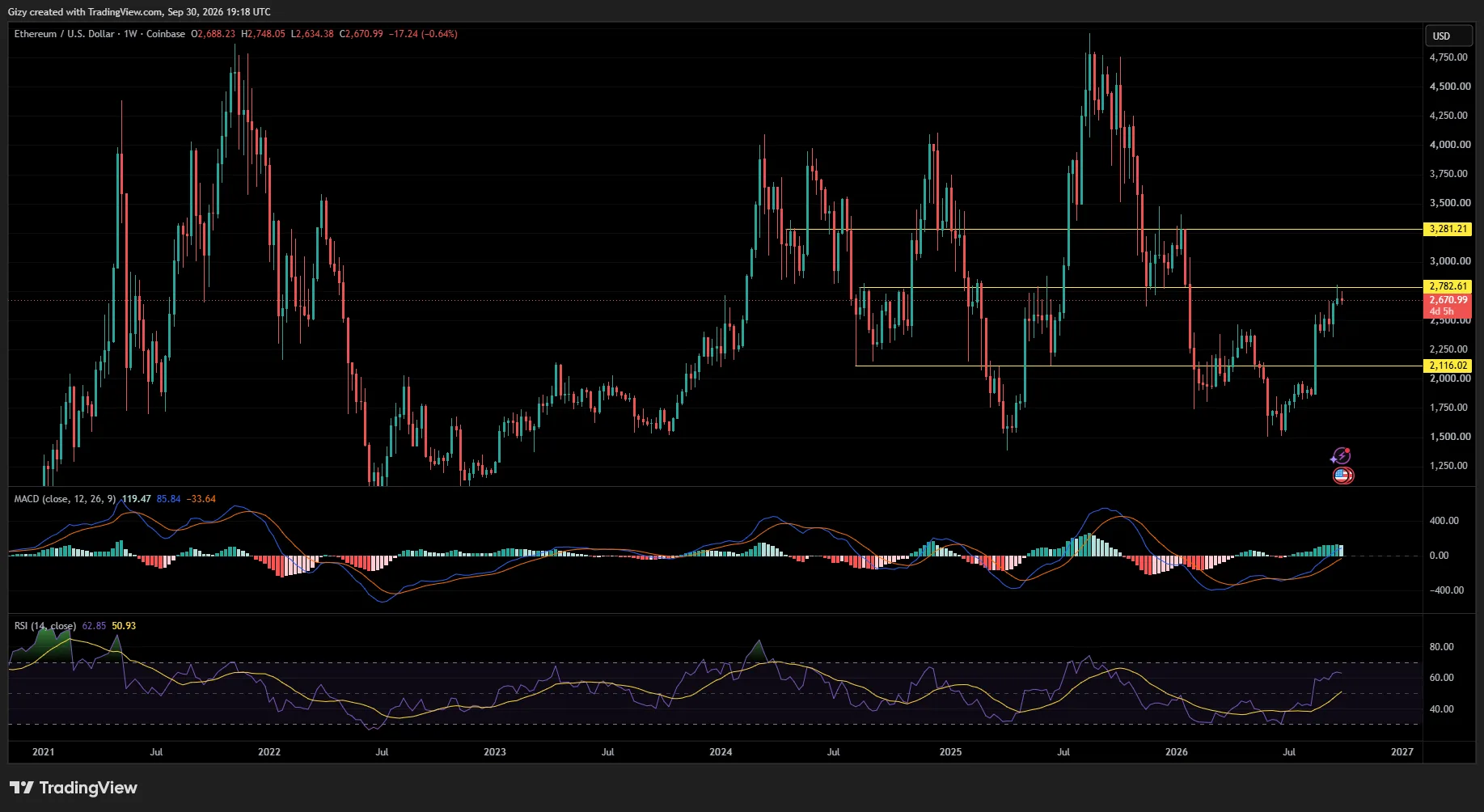
Previous price action shows that Ethereum has historically moved through these zones in different ways. When ETH traded below $2,100, it often entered the $2,100-$2,780 range through a sharp move rather than spending an extended period consolidating around the lower boundary.
This occurred twice over the last two years. There was also an instance when ETH spent roughly two weeks testing the resistance before eventually breaking through.
A similar pattern has occurred with the $2,800-$3,300 zone. When Ethereum has decisively broken above $2,800, it has generally moved toward the upper boundary relatively quickly.
Historical price action also shows that ETH can retest the lower boundary of a new range before reaching its upper target. After breaking above $2,100, for example, the asset has previously retested the $2,800 area within the early stages of the move. A move toward $3,300 subsequently became possible after ETH established itself above $2,800.
Therefore, $3,300 remains the logical upside target if Ethereum can decisively reclaim $2,800. However, the current technical setup suggests that such a breakout may not happen immediately.
What Are the Odds of Ethereum Retesting $3,300?
Previous price action indicates that Ethereum has rarely broken above $2,800 after using the $2,600-$2,700 area as its primary launchpad. Most successful attempts began from lower levels around $2,400.
If history is any guide, ETH’s current position above $2,600 does not necessarily mean that it is ready to decisively flip $2,800.
In a nutshell, historical price action suggests that the likelihood of Ethereum entering the $2,800-$3,300 range within the next 14 days may be limited. Interestingly, this view aligns with readings from the 1-day chart.
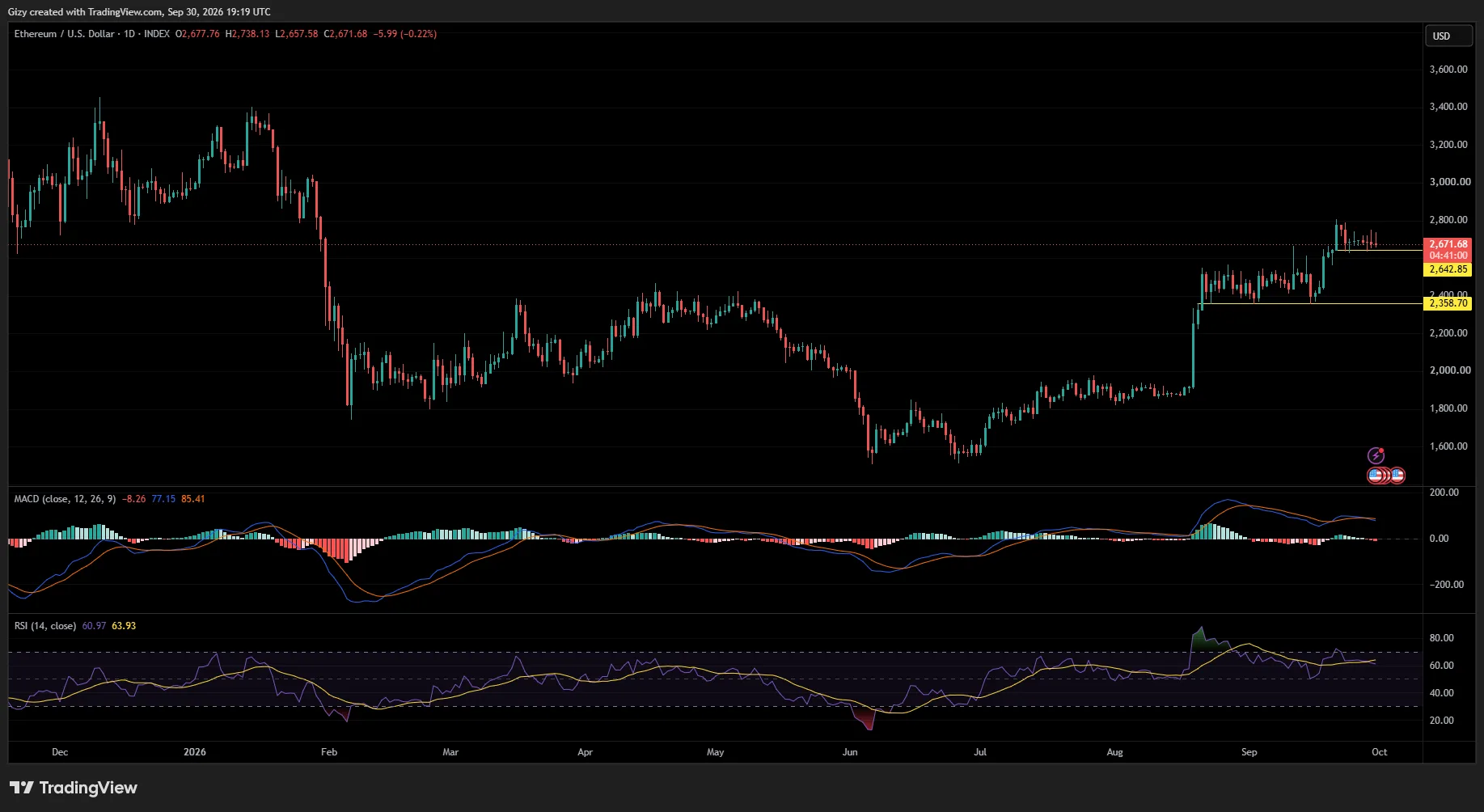
The Relative Strength Index (RSI) was above 71 a few days ago but has fallen to around 61 at the time of writing. Prices have remained rangebound while the RSI declined, indicating that upward momentum is weakening and downside risks are increasing.
Adding to the concerns is the MACD, which has formed a bearish crossover. This suggests that bullish momentum is fading and could precede further downside.
If a significant selloff occurs, $2,360 becomes the next level to watch. If the bulls fail to defend that support, ETH could fall toward $2,100.
Conversely, defending the $2,360-$2,300 area could provide a potential launchpad for another attempt at $2,800.
The preceding analysis provides a clearer picture of where an attempt at $2,800 could begin and how Ethereum may behave during the first few days of October. However, reaching $3,300 requires another step: a decisive breakout above $2,800.
Based on previous price action and the current technical setup, the odds of ETH breaking above $2,800 within the next 30 days appear limited. As a result, a retest of $3,300 also appears less likely in the near term.
However, $3,300 remains a key upside target if Ethereum can regain momentum and decisively break above $2,800. For now, the more immediate levels to watch are $2,360 on the downside and $2,800 on the upside.