AI crypto has become one of the more closely watched areas of the market. Still, it is difficult to separate real network activity from the broader narrative surrounding the sector.
This report examines five projects: Bittensor (TAO), Render (RENDER), NEAR Protocol (NEAR), Internet Computer (ICP), and the Artificial Superintelligence Alliance (FET/ASI).
The aim is to investigate how much measurable activity sits behind their AI narratives and how closely that activity is connected to their native tokens. The analysis focuses on network usage, token utility, and economic activity, while considering supply and ecosystem factors where they help explain the data.
The evidence varies considerably across the five projects. Some show a clearer connection between network activity and token demand. Others have significant activity but less evidence of economic value reaching the token.
The Research Lens
Rather than starting with price or market capitalization, the research examines each project through three questions:
- How much real activity is happening on the network?
- What role does the native token play in that activity?
- How much economic value does the network capture?
Data quality matters throughout the research. Where activity is difficult to measure independently, or project figures cannot be cleanly verified, that limitation is reflected in the analysis.
One other distinction matters: not all network activity is AI activity. Render supports both rendering and AI compute, ICP handles general computation, and much of NEAR Intents activity is unrelated to AI. The research therefore avoids treating all network activity as evidence of AI usage.
Methodology
The projects are assessed across three core areas:
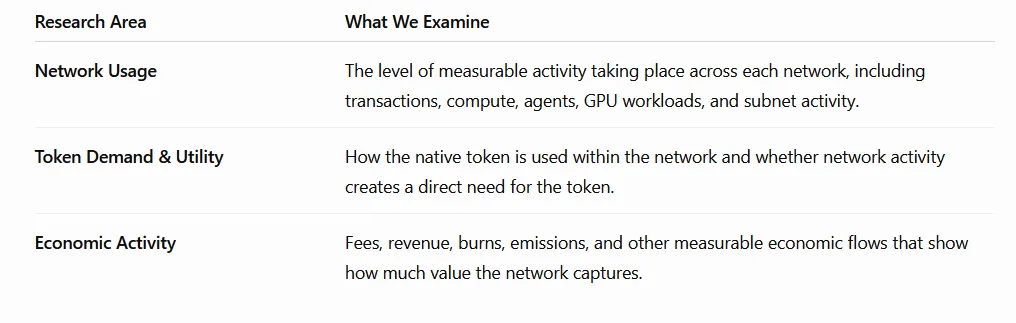
The analysis then considers AI relevance and data quality when interpreting these three areas.
AI Crypto Projects Under Review
1. Bittensor (TAO)
Market context: ~$200–210 price range; ~$2.0–2.3B market capitalization; 21M maximum supply.
Network Usage
Bittensor operates a large ecosystem of specialized AI subnets, with approximately 128 active subnets during the research period. These cover areas including inference, compute, data, and prediction. Its July 2026 Emission Gate showed 94 subnets below the new emission threshold, highlighting the wide variation in activity across the ecosystem.
Token Demand & Utility
TAO is used for staking and subnet participation, while alpha tokens support individual subnet economies. This gives TAO a direct role in network participation and incentives.
Economic Activity
Economic activity varies across subnets, with differences in flows, staking, revenue, and external demand. Estimates of subnet revenue versus emissions also vary. The December 2025 halving cut base emissions to about 0.5 TAO per block, or 3,600 TAO daily, providing a useful benchmark for this activity.
TAO has a fixed 21M maximum supply, while Bittensor continues to expand through specialized subnets covering inference, compute, data, prediction, and other AI-related applications.
AI relevance: High.
2. Render (RENDER)
Market context: ~$1.30 price range; ~$670–700M market capitalization; ~519M circulating RENDER of ~644M maximum.
Network Usage
Render operates a decentralized GPU network supporting traditional rendering alongside expanding AI and general-compute workloads. Its official dashboard reports approximately 77.1M frames rendered and 5,600 total nodes since inception. These figures show established activity, although the data does not fully separate AI workloads from traditional rendering.
Token Demand & Utility
Render’s Burn-Mint Equilibrium (BME) links completed jobs directly to RENDER demand. Payments for completed work are used to purchase RENDER, which is then burned. In July 2026, approximately 105,025 RENDER was burned across 3,440 transactions.
Economic Activity
Render’s paid jobs create a measurable economic loop because completed work leads to RENDER being purchased and burned. In July 2026, the network burned 105,025 RENDER, compared with 492,000 RENDER in emissions. Burns therefore covered about 21% of issuance, showing that network activity is creating token demand, though not yet enough to offset new supply.
AI relevance: Medium-High.
3. NEAR Protocol (NEAR)
Market context: ~$1.60–1.65 price range; ~$2.1–2.2B market capitalization; ~1.3B circulating supply.
Network Usage
NEAR is a general-purpose blockchain whose AI relevance increasingly comes through AI-agent infrastructure and NEAR Intents. Intents reports approximately $25B in cumulative volume, $2B over 30 days, and about $74M over 24 hours at the time of research.
Q2 2026 data also showed around 854,000 average daily transactions, with peaks near 3.76M, and roughly 121,000 average daily active addresses.
Token Demand & Utility
NEAR is used for transaction fees and other core network functions. Its role in the broader Intents ecosystem also creates additional activity around the token and network.
Economic Activity
NEAR’s economic activity is more visible through its fee generation than through Intents volume alone. Its official revenue dashboard reports approximately $39.5M in cumulative gross fees, including about $2.62M in gross fees and $503K in net revenue over the latest 30 days. This provides a measurable link between network activity and economic value captured by the protocol.
With more than 98% of supply already circulating, large future unlocks are less of a concern, although ongoing issuance still affects the token’s supply dynamics.
NEAR continues to develop AI-agent infrastructure alongside its multichain Intents ecosystem.
AI relevance: Medium. Much of NEAR’s measurable activity, particularly Intents volume, is broader than AI.
4. Internet Computer (ICP)
Market context: ~$2.10–2.20 price range; ~$1.2B market capitalization; ~555M circulating ICP; no fixed maximum supply.
Network Usage
ICP hosts more than one million canisters, with computation and storage measured through cycles. The network’s Mission 70 targets a major increase in cycle consumption, with a long-term target of approximately 0.77 XDR/s, compared with roughly 0.05–0.07 XDR/s at the time of writing.
Token Demand & Utility
ICP has a direct link between network usage and token consumption: ICP is converted into cycles, which pay for computation and storage, and the ICP used is burned. This gives the token a clear role in accessing network resources.
Economic Activity
ICP’s economic activity is closely tied to cycle consumption. The 2026 data shows approximately 83,000 ICP burned in January, 100,000 in May, and 25,000 in July. These figures show measurable token consumption, although current demand remains well below the levels targeted by Mission 70.
AI relevance: Medium. ICP provides general-purpose computation, so the available network-wide figures cannot be treated as purely AI activity.
5. Artificial Superintelligence Alliance (FET)
Market context: ~$0.13–0.14 price range; ~$300–350M market capitalization.
Network Usage
FET has a substantial AI-agent ecosystem through Agentverse. Independent research identified more than 36,000 registered agents during Q1 2026. However, registered agents should not be treated as economically active agents. The available data does not establish how many agents were actively processing tasks or generating economic activity.
Token Demand & Utility
FET is used for staking, network participation, and agent-related infrastructure across the ASI ecosystem. The ASI merger consolidated the ecosystem around a common token economy, giving FET a direct role in ecosystem participation.
Economic Activity
The main challenge is establishing how much agent activity translates into sustained economic demand for FET. Unlike networks with directly measurable burns or protocol revenue, the available evidence provides a weaker link between observable activity and economic value captured by the token.
AI relevance: High.
Comparative View
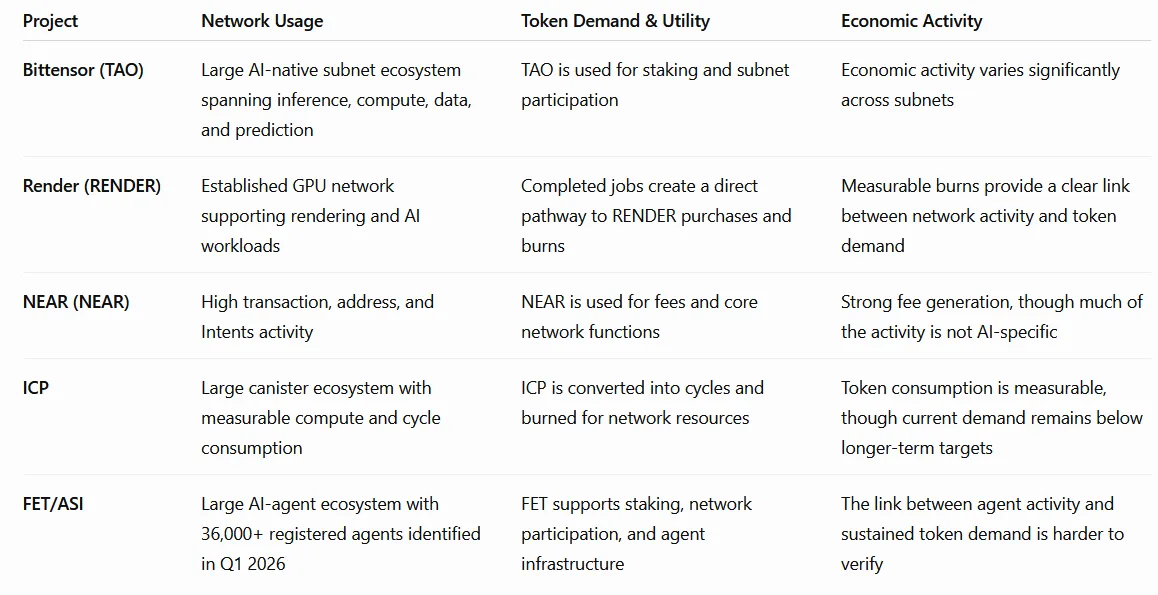
The table is not intended to identify a single winner. It shows where each project currently has stronger or weaker evidence.
Qualitative Assessment

What the Data Suggests
- Activity does not equal economic value
High transaction counts, agent populations, or GPU activity show usage, but not necessarily productive or economically meaningful demand.
- Token utility matters when tied to productive activity
The strongest cases connect network usage directly to token consumption, fees, revenue, or other measurable economic activity.
- AI activity must be separated from broader network activity
Transaction volume, compute, and settlement activity should not automatically be treated as AI usage. The key question is whether productive AI activity creates measurable economic value for the network and its token.
Limitations
- The projects generate different types of activity, which limits direct comparison.
- AI-specific usage cannot always be separated from broader network activity.
- Some usage and economic estimates rely on third-party methodologies.
- The five projects represent a focused sample, not the entire AI crypto sector.
Conclusion
AI crypto is moving beyond the narrative, but the evidence of real utility remains uneven.
Render provides the clearest link between productive network activity and token demand through its burn mechanism. Bittensor has strong AI-native usage and direct token utility, although economic activity varies across subnets. NEAR shows strong economic activity through fees and settlement volume, but much of its measurable activity is not AI-specific. ICP has a clear link between computation and token consumption. And FET/ASI has substantial agent infrastructure but weaker evidence connecting that activity to sustained token demand.
The broader finding is that network activity alone is not enough. The strongest evidence comes when productive activity creates measurable economic value and a clear reason to use the native token. The closer a project gets to that full economic loop, the stronger the evidence for genuine utility beyond the AI narrative.







 Ephraim Emmanuel | October 20, 2026