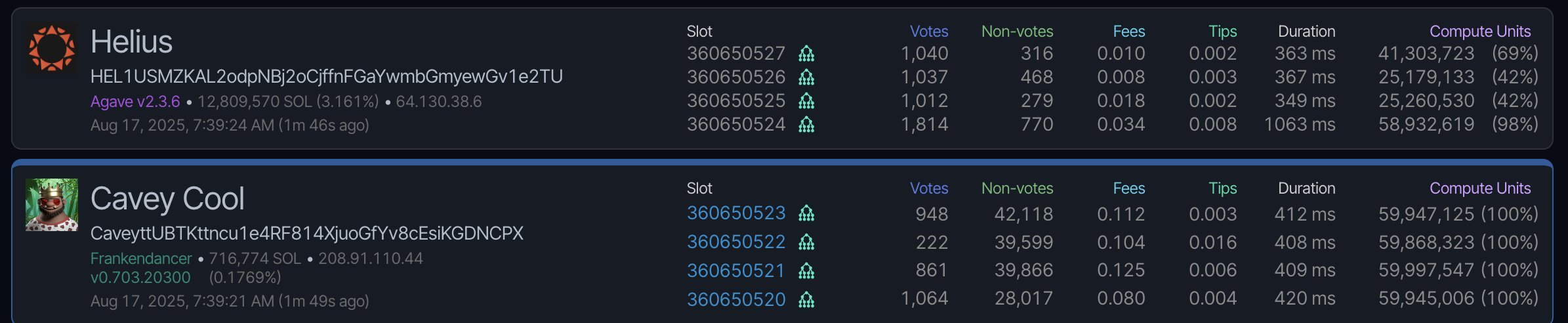
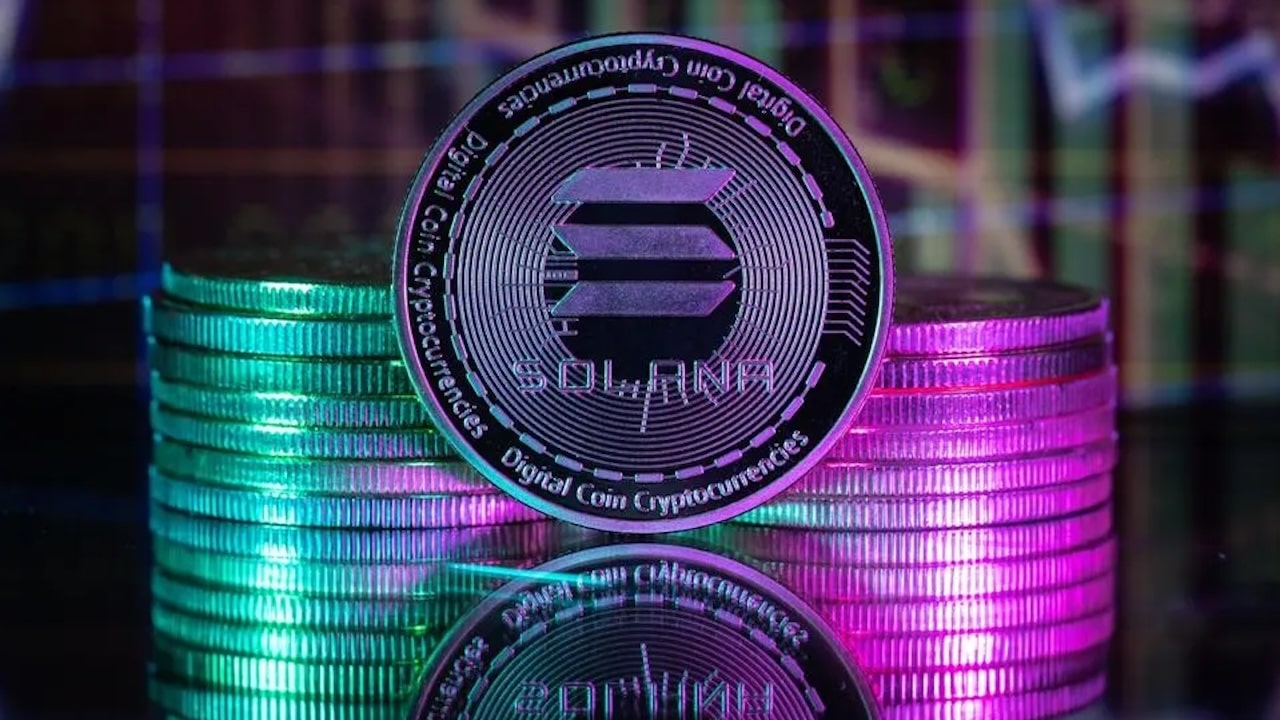
In an eye-catching experiment, a Solana developer has demonstrated that under certain conditions, the blockchain network can handle over 100,000 transactions in a second. Specifically, the Cavey Cool validator was able to process a total of 104,562 transactions in four blocks added to the Solana mainnet.
100K Solana TPS Experiment Explained
To understand the latest experiment, it is vital to know how the Solana network currently works. Under normal circumstances, the Solana network handles an average of 3500 transactions per second, according to data from Solscan.
A majority of these transactions are “vote” transactions, which allow validators to communicate network state and process transactions. Only around 1200+ transactions (referred to by many explorers as True TPS) are “non-vote transactions”, that is, actual transactions by everyday Solana users.
However, the latest experiment pushed those boundaries by tweaking the nature of the transactions. For one thing, the developer did not change the vote transactions, as doing so makes it relatively difficult for validators to acknowledge and add the blocks to the network.
Instead, the developer changed the type of non-vote transactions, allowing more transactions to fit into a single block. Recall that a simple transaction to send SOL to another address and a transaction to swap tokens on the Jupiter platform do not use the same amount of resources from the Solana network. The latter is more complex and thus involves more fees.
In this case, the developer used so-called “no-op transactions,” which require significantly fewer resources for the Solana network to process. Think of no-op transactions as small parts of your everyday Solana transactions, but they are still large enough to be considered a transaction on the network.
By filing Solana blocks with a large chunk of these no-op transactions, the developer achieved a remarkable result where four accompanying Solana blocks settled a combined 104,562 transactions in one second. As Cavey notes, no-op transactions “still require signature verification and VM instantiation” and thus cannot be considered trivial in terms of their demand on the Solana network.
The blocks consisted of votes, a few normal transactions, and a significant number of “no-op” transactions. Although these no-op transactions consume 1 compute unit at runtime, their total cost to the network is 1030 units. Like other transactions, these still require signature… pic.twitter.com/6GpxuBO6bD
— dr cavey phd ⏳ (@cavemanloverboy) August 17, 2025
Latest Experiment Shows What’s Possible
The latest development is noteworthy. For one thing, while such transactions have previously been successfully executed on Solana’s test network, this arguably marks the first time it has been successfully replicated on the Solana mainnet.
Thus, it demonstrates, in line with recent developer efforts, what’s possible when Solana reaches its peak performance. As Cavey added, if Solana developers can build more efficient token standards and onchain programs, then the network could theoretically handle tens and potentially hundreds of transactions per second in the coming months and years.
Get Trending Crypto News as It Happens. Follow CoinTab News on X (Twitter) Now






 Ephraim Emmanuel | February 13, 2026
 Mishael Nwani | February 13, 2026
 Chris Lion | February 12, 2026
 Cynthia Ezirim | February 12, 2026