
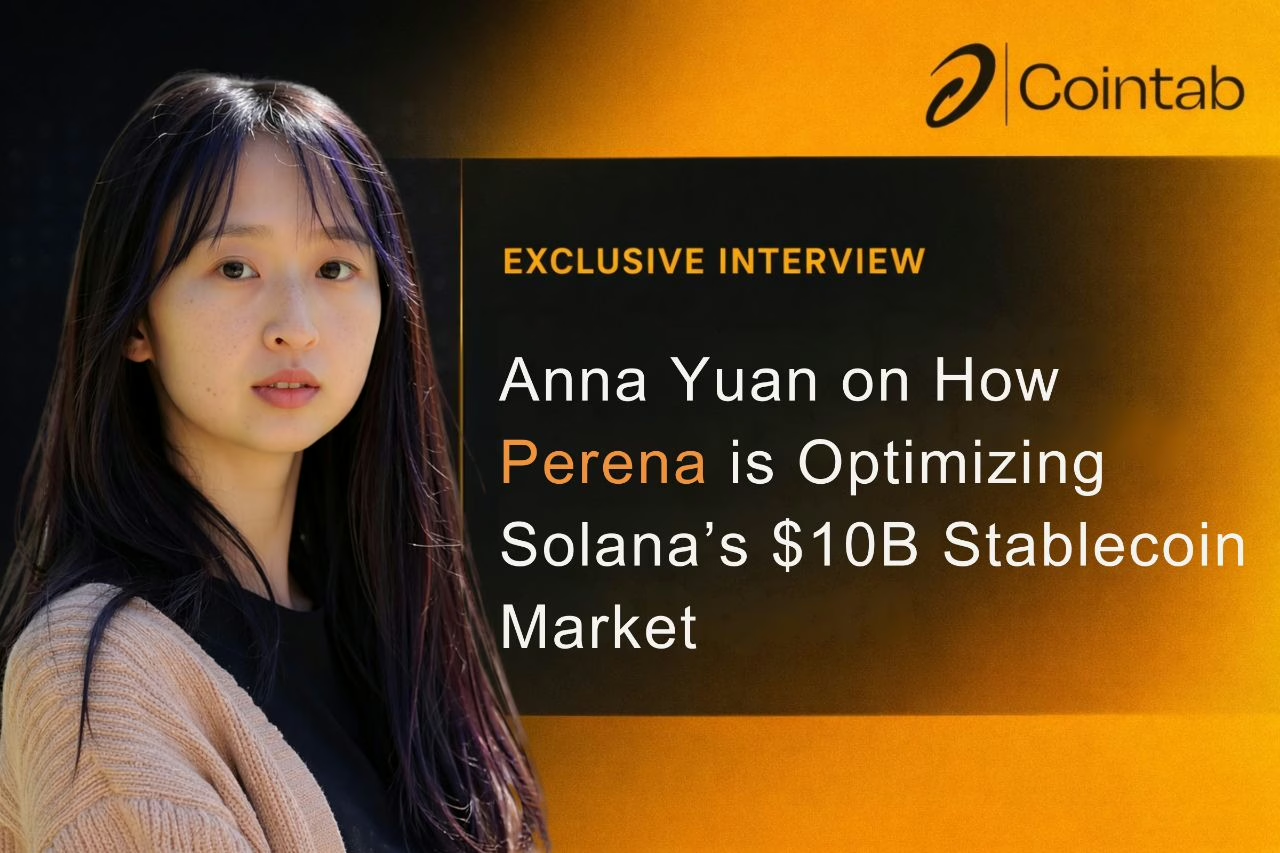
For years, stablecoins have powered activity across Solana, quietly settling trades, anchoring DeFi, and holding billions in value.
However, according to Anna Yuan, Founder and CEO of Perena, the ecosystem has been overlooking a structural flaw. “We’re funding our own competition,” she says, pointing to the hundreds of millions in annual interest generated by stablecoins on Solana that ultimately flows back to issuers like Circle and Tether, firms actively supporting rival networks.
We recently discussed with Anna, Founder and CEO of Perena, to unpack how that realization took shape, from her early days experimenting with Ethereum in 2017, to a stint at ConsenSys, to advising a major payments client at McKinsey & Company, and ultimately leading stablecoin initiatives at the Solana Foundation. Anna also shared deep insights into how Perena has evolved and its long-term vision.
First, though, she gave us a brief overview of her background in the crypto space.
Background in Crypto and How Solana Shaped Her DeFi Perspective
Anna got into crypto in 2017 through friends in the high-frequency trading space who pointed her at Ethereum (as a fun fact, Solana was not even born at the time). She worked briefly at ConsenSys but found Ethereum too hard to use for what she cared about, which was, even back then, this vague idea that stablecoins could be used in real life as better money.
Fast forward to 2020 — Anna was at McKinsey working on a payments client, a company most people would recognize that’s now active in the stablecoin space. That experience crystallized for her how broken traditional payment rails are and how high-performance blockchains could actually fix this. Friends at Solana Labs introduced her to the ecosystem, and it clicked — Solana had the throughput and cost structure to make real financial products viable.
This led to a new role where Anna led the stablecoin initiative at the Solana Foundation. What shaped her perspective on this “front-row seat” job? She mentioned two things.
“First, Solana’s yield market is extremely nascent — if a $10 billion hedge fund wanted to deploy on Solana today, there’s nowhere for them to go without blowing out every market. The on-chain economy is fragile. Second, I realized the ecosystem was hemorrhaging value — over $500 million annually in interest income flowing to stablecoin issuers [evidently referring to Tether and Circle] who were using that revenue to fund competing chains. That realization became the thesis for Perena.”
Anna shed more light on the hemorrhaging issue facing Solana’s stablecoin ecosystem and how Perena hopes to make things right.
Inspiration behind Perena and key issues driving its formation
“The core issue is straightforward,” Anna began. “Solana has over $10 billion in stablecoins, and the interest on that — roughly $500 million a year — goes to issuers like Tether and Circle. Circle has a public revenue-sharing deal with Coinbase, which builds Base, a direct Solana competitor. Tether supports Plasma and other competing chains. We’re literally funding our own competition.”
She had been hearing from users that APYs were too low, indicating clear demand for higher-yield products. From her Solana Foundation experience, she knew the ecosystem needed to import yield — like Madagascar importing goods. She viewed Solana as a small digital economy that needs to bring in external yield sources to strengthen its financial infrastructure.
Anna Yuan also believed — and still does — that regulated fiat-backed stablecoins are becoming commoditized. The real differentiation is in yield-bearing DeFi products, and Perena exists to build that differentiated layer.
She explained the project’s core mission in one sentence,
Perena is building the crypto-native asset manager that makes institutional-grade yield strategies accessible to everyone through on-chain products — starting with USD*, our yield-bearing stablecoin fund-of-funds.
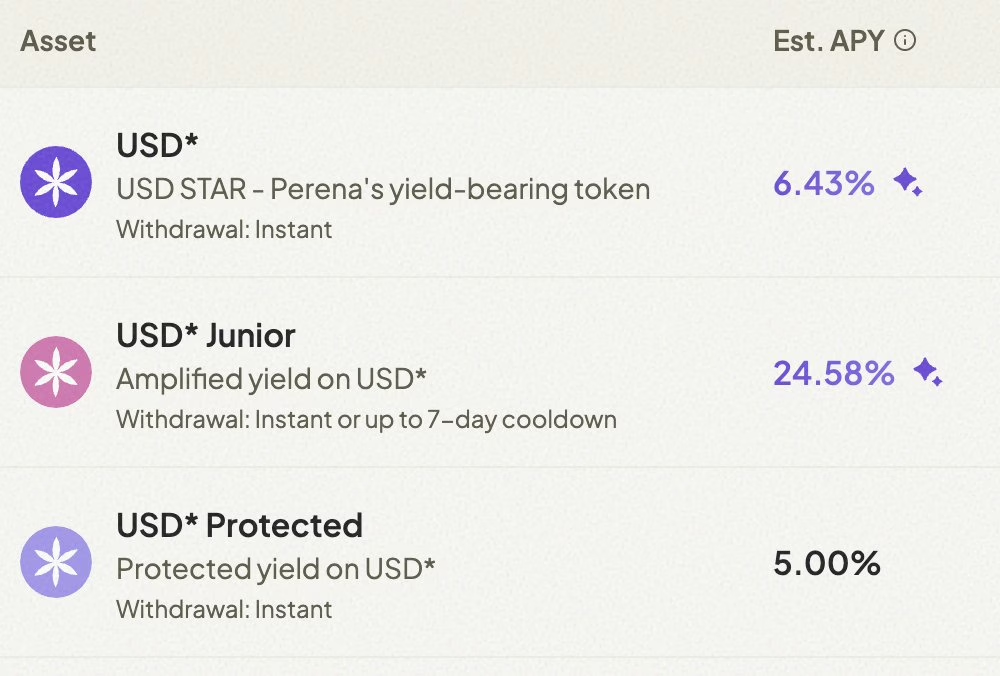
Perena’s USD* is so simple that it can just sit in your Solana wallet and quietly earn you yield without needing to lock the token. Users can swap out of the token at any time to realize accumulated yield.
From Numéraire to Perena
What many do not know is that Perena isn’t the first iteration of the project’s effort to make stablecoin yields more solid and attractive. Anna was honest about the project’s evolution and told CoinTab News,
“When we launched, our first product was Numéraire, a novel stablecoin AMM designed specifically to address liquidity fragmentation — unifying stablecoin liquidity into a single pool rather than fragmenting it across pairs. That product processed over $2 billion in volume on Solana.”
However, the AMM model made the project less capital-efficient, and Anna led the team to do what most crypto projects fail to do: recognize that a product is not working and pivot. She said, “One of the biggest lessons I learned as a founder is to fail fast. AMMs are capital-inefficient — I knew that going in, and the data confirmed it. So we evolved.”
Today, Perena addresses a different dimension of the fragmentation problem: yield fragmentation. There are dozens of high-quality yield sources scattered across chains and protocols — delta-neutral strategies, secured lending, RWAs — but no single product aggregates them intelligently.
USD* is [Perena’s] answer: a mega-vault architecture that dynamically allocates across multiple underlying vaults, each targeting a different yield source. We can add vaults, remove vaults, and rebalance — acting as an actively managed fund of funds rather than a static AMM.
Here are some notable numbers that Perena has achieved since its Numéraire days.
- $2B+ in cumulative volume through Numéraire
- $130M net USD* minted (and many burned)
- USD* generating ~10% APY from diversified yield strategies, consistently since launch
- 35% of users are new to Solana — meaning we’re bringing net new capital to the ecosystem, not just recycling existing TVL
However, these numbers have not come without challenges. Anna Yuan shared the company’s biggest challenges across product, regulatory, and market areas.
Technical, Regulatory, and Market Challenges
On product, Anna Yuan told CoinTab News that her “biggest misstep was not failing fast enough.” She wishes she had not spent a few extra months perfecting Numéraire and had shipped a more valuable product, like Perena, sooner. Also, as was common at the time and is probably still, Perena followed “what everyone else was doing — points programs, token expectations — instead of focusing on what would actually generate the highest outcome for users.”
Perena has since revamped its reward mechanism for users, focusing more on rewarding long-term users, rather than mercenary capital.
On the regulatory front, Anna Yuan explained that Perena “deliberately chose not to call USD* a stablecoin but a stablecoin-based on-chain financial product.” For Perena, that distinction matters, and the firm prefers that users do not simply view USD* as a stablecoin, because the token is more than that.
Additionally, since the firm cannot use words like “bank” or “financial services” without triggering regulatory scrutiny, it has had to be creative with terminology while remaining honest about what the product is. Perena continues to navigate decisions on incorporation structures and to work with counsel on frameworks that enable the product to scale responsibly.
On the market front, the Perena founder expressed a slight dissatisfaction with crypto markets, judging DeFi projects by TVL. She argues that this creates “perverse incentives,” leading most teams to “PvP-ing each other’s deposits and driving rates artificially high.”
Perena does things differently by trying to play a positive-sum game. The project focuses on “importing fresh yield from off-chain and cross-chain sources rather than just competing for the same on-chain capital.” Even though it is a harder approach, it’s more “sustainable,” as Anna claims, and the project will continue to do it.
She also shared some brief insights into the challenges of being a solo female founder in a highly competitive field like crypto. She noted:
“I’m the only solo female founder I’m aware of in this space. The hardest decisions — killing a product, restructuring the team — are mine alone. Over the past year, I’ve learned that collecting advice from 15 people over three days is usually less productive than making a guesstimate and iterating as you get new information.
User Adoption and Ecosystem Growth
Perena’s simple and appealing design has helped attract high-quality depositors. “We have institutional participants who have deposited millions into USD*, which is a strong trust signal. We’re building trust through transparency: audited reports from TradFi third-party service providers shared with KYB-whitelisted institutions, and a public dashboard that shows our exposure to protocols such as Drift, Kamino, and others,” the Perena founder and CEO said.
Another interesting metric is that “adoption has been organic.” The project has not done any aggressive incentive campaigns yet. Instead, the yield speaks for itself.
“When you’re generating double-digit returns from diversified strategies while most of the market is offering single digits. What we’re seeing is that once institutional depositors come in and are satisfied, they become our best distribution channel,” Anna concluded on ecosystem growth.
Upcoming Announcements and Roadmap
Anna Yuan also shared a few things the Perena community should watch out for in the coming months. Impressively, some of these iterations and new products have now been launched since CoinTab News interviewed the Perena founder.
- Structured products: We’re exploring tranching — senior/junior vaults with different risk-return profiles — so users can choose their risk appetite. Think of it like choosing between a money market fund and a high-yield bond fund. (Now Live)
- Broader yield source diversification: We’re actively onboarding new yield sources, including RWA integrations and off-chain strategies. The goal is to look more like an S&P 500 for yield — not based on market cap, but on our ability to source diversified, high-quality alternatives (Ongoing)
- Perena Purple: our VIP program with institutional-grade research reports and early deal access (Now Live)
Three to Five-Year Vision and Multi-Chain Strategy
Looking forward, Anna believes that in three to five years, “Perena should look like the 21st-century asset manager — what Fidelity or BlackRock would be if they were built from scratch on permissionless rails.”
She continued, “We won’t be in our current form. What we are today is a starting point, and like a perennial plant, we’ll keep blooming in new forms.”
On multi-chain, she explained that the project is already expanding beyond Solana. While Solana remains Perena’s home ecosystem, she admits that “yield doesn’t respect chain boundaries.”
Therefore, “if there’s a compelling yield source on another chain, [Perena] should be able to access it for our users. The architecture [it has built] supports this — USD* as a cross-chain yield-bearing asset that aggregates the best opportunities regardless of where they live.”
Long-term, Anna Yuan wants “Perena to be the place where anyone in the world can access the same quality of financial products that hedge fund LPs and family offices currently get. The stablecoin is just the entry point. The vision is a full-stack, crypto-native asset management platform — alternatives going mainstream, but on-chain.”
Get Trending Crypto News as It Happens. Follow CoinTab News on X (Twitter) Now








 Sampson Gideon | March 5, 2026
 Michelle Abigail | February 23, 2026


 Elendu Benedict | May 24, 2024
