The Bitcoin mining difficulty has recently attained a new all-time high (ATH) of over 136 trillion. This increase indicates that more miners are joining the Bitcoin mining ecosystem, as they compete for block rewards.
What is Bitcoin Mining Difficulty?
For context, Bitcoin mining difficulty refers to the level of difficulty involved in mining new blocks. Ideally, Bitcoin miners compete to solve mathematical problems (called cryptographic puzzles) within 10 minutes.
Whenever these complex calculations are completed too quickly or too soon, the mining difficulty automatically adjusts after 2,016 blocks, which is attained in two weeks. Miners are rewarded 3.125 BTC after solving these mathematical puzzles.
This approach helps to keep the Bitcoin network stable, as the block creation process becomes fairly predictable and BTC coins do not oversaturate the market. It also bolsters the blockchain’s security.
A New ATH
According to on-chain data from the blockchain analytics platform CryptoQuant, Bitcoin’s mining difficulty has been on a steady surge over the past two months.
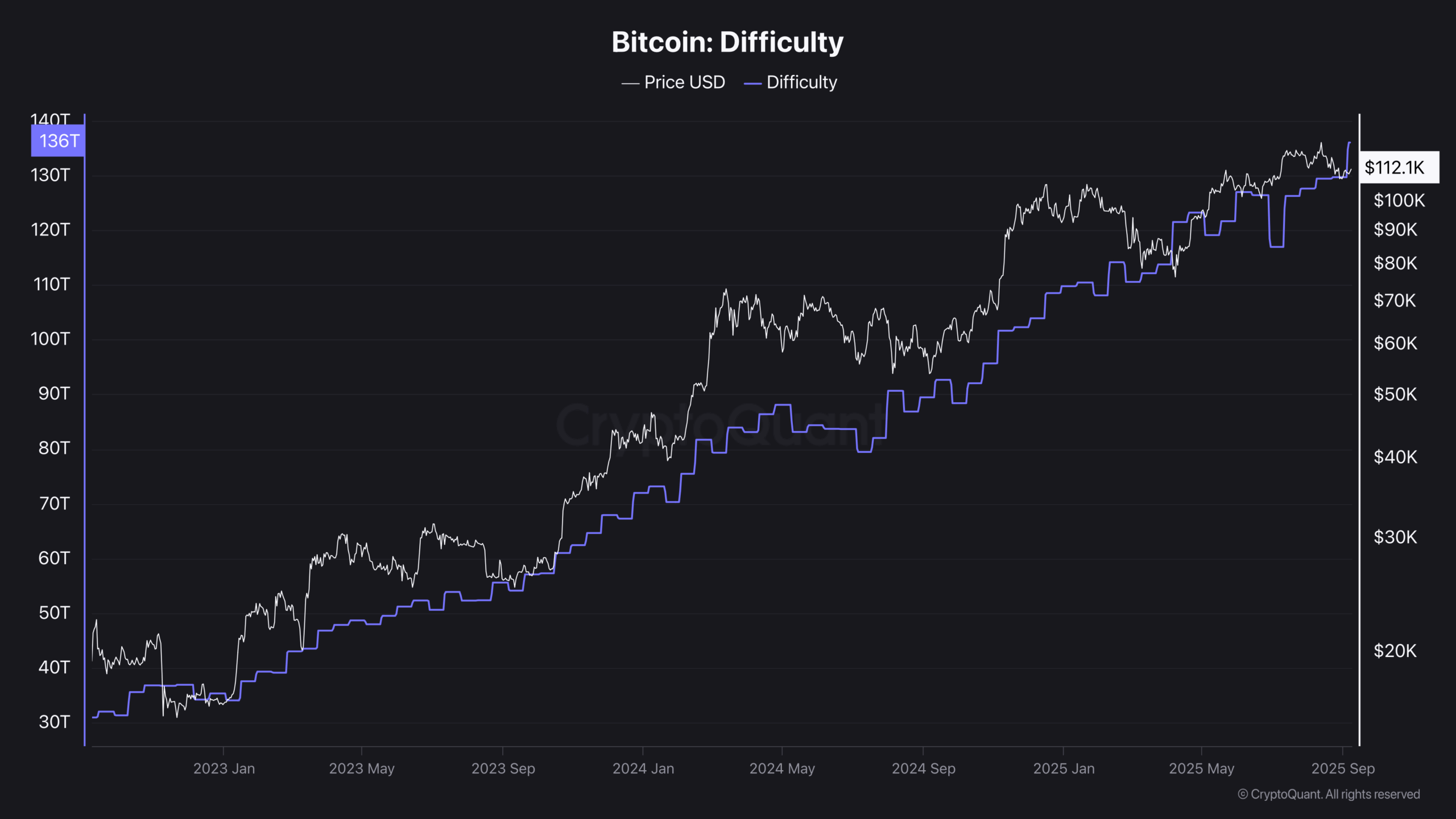
On July 9th, the mining difficulty was above 116.958 trillion. However, the metric has been on an uptrend ever since then. Notably, this coincided with when BTC began experiencing a significant price surge to its current all-time high of $123,300 in August.
Around that same period, some industry leaders like American Bitcoin have joined the blockchain’s mining business.
Additionally, Bitcoin miners like CleanSpark stepped up their game by increasing their mining machines. This way, they can gain a hedge among competitors to generate more hashrate. The hash rate refers to the computing power a mining rig has to solve mathematical problems and mine new blocks. Typically, more mining rigs mean higher hashrates. In turn, a higher hashrate causes an increase in the mining difficulty.
According to CryptoQuant’s data, Bitcoin’s hashrate is currently at 1.041 trillion, the highest over the past week.
Meanwhile, BTC’s current trading price sits at $112,100. Although this price represents 2.75% increase in the past week, it is still over 10% below its all-time high.




 Jonathan Agozie | October 20, 2026
 Ephraim Emmanuel | October 20, 2026